Arrival of Hindus at the "Chaplaincy Table"
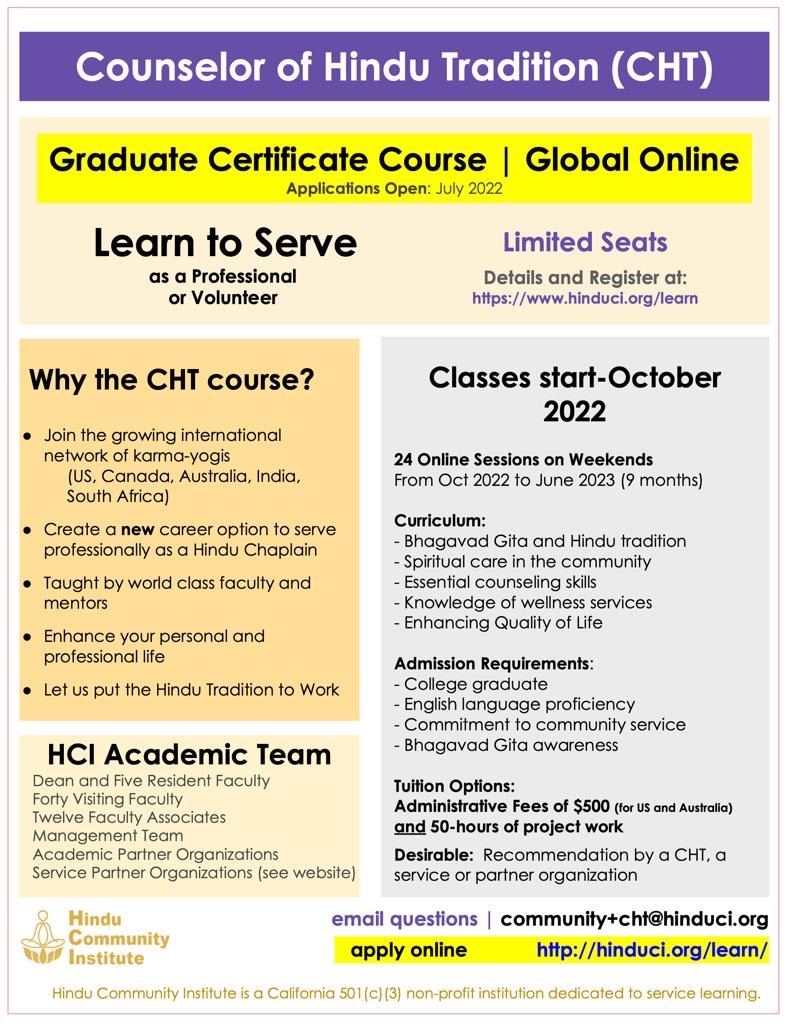
Very often in life, we find ourselves in need of support for emotional or spiritual issues or to restore a sense of community and belonging. In institutional settings, it is a chaplain's job to build relationships within the community, create support groups, and aid members in dealing with grief, anger, or depression. Where chaplains are employed, the jobs are filled by ordained Christian clergy, and increasingly by persons of other faiths, such as Islam or Judaism. The vocation of "Chaplaincy" has become universal, generic, and readily accepted by all major traditions. The evolution of interreligious chaplaincy has increasingly brought these services to the common human framework.
If we don't have Hindu chaplains as guides to serve people from our faith and tradition then that gap gets filled by people who give their voice to our faith.
However, Hindus have not followed this path to chaplaincy, instead leaving followers of other faiths to minister to needs at our most vulnerable times in life. We need to change this, and I am amongst the first set of trained Hindu Chaplains to enter this path.
Among Hindus, the term chaplain is still not very familiar. A chaplain is, traditionally, a cleric (such as a minister, priest, pastor, rabbi, purohit, or imam), or a lay representative of a religious tradition, attached to a secular institution (such as a hospital, prison, military unit, intelligence agency, embassy, school, labor union, business, police department, fire department, university, sports club), or a private chapel. (Wikipedia contributors, 2022)
Chaplaincy was originally understood in a Christian context but as defined above and in settings like healthcare and education it is growing in various faiths like Judaism, Islam, Buddhism, Hinduism etc.
The Hindu diaspora needs to appreciate the need for spiritual care, as we now live in scattered communities instead of joint families or village environments. Accommodating Hindu religious practices in the above mentioned settings is the gap we need to address. If we don't have Hindu chaplains as guides to serve people from our faith and tradition then that gap gets filled by people who give their voice to our faith. A Hindu chaplain or a spiritual caregiver is a person who supports Hindu care recipients in our communities both in public and private institutions, a "go to" resource where one can expect authentic advice within the protocols of privacy and respect.
The vision of HCI, since its founding in 2018, has been to institutionalize spiritual care by training counselors and chaplains. All the training programs are founded on Hindu Vedic traditions and values.
Neeti Soota, MSI am privileged to be among the first professionally trained Hindu chaplains who completed the Counselor of Hindu Tradition (CHT) course at HCI in 2021 and am now in the process of completing my Chaplaincy Program (ICP course) at Graduate Theological Union (www.gtu.edu) in 2022.
The vision of HCI, since its founding in 2018, has been to institutionalize spiritual care by training counselors and chaplains. All the training programs are founded on Hindu Vedic traditions and values. It is therefore important that the community participates in the HCI activities and supports it by way of volunteer time and donations. The trained Hindu counselors and chaplains will serve Hindus and others with appropriate sensitivity and respect. The guiding principle of HCI training and education is "Vasudhaiva Kutumbakam" or the universe is one family.

Neeti Soota, MS
Neeti Soota is a 2021 graduate of the CHT course. She is among the first three scholars from HCI to enter the Chaplaincy course at Graduate Theological Union. She serves as Assistant Registrar at HCI.