Chaplaincy: A New Frontier in Hindu Seva

Success for a community comes from sound economic status and engagement on matters of interest of the greater community. While the prosperity and education of the Hindu community have been significant achievements, it is much less so when it comes to their participation in the welfare of the more significant inter-religious community. Today, it would be unusual, even remarkable, to go to a hospital, university, or tech firm and not see an Indian face in a prominent position. However, ironically, there are critical spaces where the Hindu faces are expected but mostly absent. The Hindu Community Institute (HCI) is now addressing this absence in the spiritual care domain through first-of-its-kind programs.
Historically, as immigrants assimilated, their way of life became familiar and less "alien" in the US. For example, the Irish, Germans, Italians, and Jews have all followed this trajectory. Indians and Hindus started arriving after the 1967 immigration regulations and in these fifty years, have risen to the highest level of education and income. But unlike the Jewish community, who have created significant institutions like hospitals and universities and are known to be generous with charitable and civic causes, such efforts by the Hindu communities have not been active and visible.
The mainstreaming of the Hindu tradition will not be complete until it is represented commensurate with its material and spiritual wealth.
Kailash Joshi & Gaurav RastogiOne prominent space with glaring Hindu absence has been "Spiritual Care and Chaplaincy." The mainstreaming of the Hindu tradition will not be complete until it is represented commensurate with its material and spiritual wealth. To be sure, the Hindu way of life is already familiar. Yoga, Vegetarianism, Meditation and Mindfulness, Eco-spirituality, and the increasing prevalence of cremation are just a few ways essential Hindu practices have become mainstream. But the typical person does not necessarily attribute these practices to the Hindu tradition.
With the initiative of the Hindu Community Institute, there is an emergence of "Hindu Interreligious Chaplains" who can serve in institutions such as the military, hospitals, and universities. Towards this end, HCI started the Counselor of Hindu Tradition (CHT) course in 2018 and created the Hindu Chaplaincy Pathway to Hindu Interreligious Chaplaincy in 2021. HCI is simultaneously working to establish a global network of 1008 CHTs Counselors and 108 Hindu Chaplains by 2026-27. It expects to reach 30% of this goal in 2023.
For those desiring Hindu spiritual practices, the providers will be ready with their Hindu "kit of tools" of Yoga, Meditation, Ayurveda, Pranayama, Prayers, Bhajan, and Havans.
A non-profit in its charter, HCI is managed as a well-run corporation by a dedicated volunteer team or Sangha of 250 faculty members, management, instructors, and staff. HCI's planned global network of CHT and Interreligious chaplains will be reachable worldwide by people needing spiritual care and guidance. These service providers will be guided by the Hindu tradition of "Vasudhaiva Kutumbakam" or universal family. Their culturally sensitive services will be available to all, regardless of race, religion, and status. For those desiring Hindu spiritual practices, the providers will be ready with their Hindu "kit of tools" of Yoga, Meditation, Ayurveda, Pranayama, Prayers, Bhajan, and Havans.
Mainstreaming will be complete when all Interreligious institutions can readily access Hindu Interreligious Chaplaincy services. We expect this to happen in impactful ways in the next ten years.
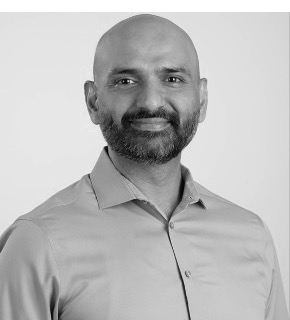
Gaurav Rastogi, MBA, ERYT-500
Gaurav Rastogi is a Board Member and Dean of HCI. He has led executive roles at large companies and startups as a professional. Mr. Rastogi holds an MBA from IIM Ahmedabad and a Mechanical Engineering undergrad from Delhi Technological University (DCE). He is the author of three business books and several podcast episodes on the future of work. He is a Dhyana meditation and yoga teacher and has taught in Silicon Valley for several years.

Kailash Joshi, Ph.D., D.Sc. (Hon.)
Kailash Joshi is President of Hindu Community Institute. He is a retired IBM division GM and has been engaged in managing positions and mentoring of entrepreneurs and startups in Silicon Valley. He is also a co-founder of TiE (www.TiE.org) and AIF (www.aifoundation.org). He holds a Ph.D. degree in engineering from Cornell University and was awarded a honorary Doctorate by Garhwal University in Uttarakhand, India.