Recognizing Oneness: the Isha Upanishad as a Path to Empathy
यस्तु सर्वाणि भूतान्यात्मन्येवानुपश्यति ।
सर्वभूतेषु चात्मानं ततो न विजुगुप्सते ॥ ६ ॥
Who sees everything in his Atman in
everthing, by that he feels no revulsion.
यस्मिन्सर्वाणि भूतान्यात्मैवाभूद्विजानतः ।
तत्र को मोहः कः शोक एकत्वमनुपश्यतः ॥ ७ ॥
When to the knower, all Bhutas (living entities) become
one with his own Atman, what perplexity, what grief, is
there when he sees this oneness.
—Ishavasya Upanishad Verses 6 & 7
When studying Vedanta, we encounter the recurring theme that human suffering arises from seeing oneself as distinct from others. In the above verses from the Isha Upanishad, it is emphasized that true contentment can be found by regarding the Atman (true self) as universal in all beings. "The Atman is common in the king and the peasant, the saint and rogue, the cobbler and the barber, the ant and the elephant, the tree and the stone. How can that great soul who is resting in his own Atman and who has such an exalted cosmic consciousness shrink from any being with a feeling of revulsion? How can he hate anybody? Absolutely impossible."2
The Isha Upanishad affirms our capacity as humans for tremendous empathy and declares the deep interconnectedness of all existence.
What significance do these verses hold for chaplaincy?
The Isha Upanishad affirms our capacity as humans for tremendous empathy and declares the deep interconnectedness of all existence. Swami Krishnananda mentions that the Isha Upanishad is simply the phrase "love thy neighbor as thyself" taken to its logical limit where we recognize the unity of all beings.3 At HCI, we are embarking on training chaplains who are well-versed in Hindu tradition(s) and who can also serve as interfaith chaplains. Chaplains who graduate from the HCI-GTU programs will provide spiritual and social support to anyone in need, regardless of religion, cultural background or socioeconomic status. By using the principles of this Upanishad as a foundation for chaplaincy, we can effortlessly approach others on the basis of our shared humanity and differences are not permitted to become barriers.
The Isha Upanishad encourages us to view all of existence as an indivisible "whole." Chaplaincy work performed from this perspective, as karma yoga, acknowledges the inherent divinity of all beings.
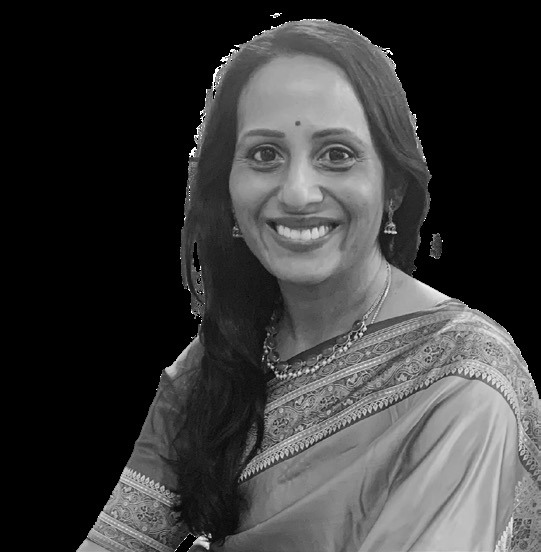
Dr. Lakshmi SrinivasanIn Sri Madhavacharya's commentary on this Upanishad he states "a person who sees the supreme Self in all beings will become fearless; they will not need to guard themselves."4 Seeing the world as an extension of ourselves provides the assurance that kinship is possible in any environment. This perspective allows us to confidently offer our friendship and compassion.
The Isha Upanishad encourages us to view all of existence as an indivisible "whole." Chaplaincy work performed from this perspective, as karma yoga, acknowledges the inherent divinity of all beings and reminds us that we are each an abiding part of the universal Self.
References:
1 Lectures on Ishavasya Upanishad by Swami Tattwamayananda, Vedanta Society of Northern California, San Francisco, delivered March 2nd, 2012
2 Ishavasya Upanishad, commentary by Swami Sivanananda, Divine Life Society, 1941
3 Ishavasya Upanishad for Beginners, Swami Krishnanda, Divine Life Society
4 Isopanisad, Madhva Commentary, Srisa Chandra Vasu, 1909
Lakshmi Srinivasan, M.D.
Dr. Lakshmi Srinivasan is a practicing physician in Northern California. She is Chair of the Kutumba Editorial Board and a graduate of the CHT program. She is passionate about Vedanta studies and their application to chaplaincy and community service.