Kutumba · Journal of Spiritual Care

kutumba

Journal of Hindu Spiritual Care
Volume 4 | Fall 2024
Download Full PDF
From the Editorial Board

Way Forward

We are pleased to present to you the Fall 2024 issue of Kutumba, Journal of Spiritual Care. This publication supports the mission of Hindu Spiritual Care Institute (HSCI), which was founded in 2018 as a unique service-learning institution for the global Hindu diaspora. We have structured this issue in three sections: the fruits of ten years of untiring community effort to create Hindu chaplaincy and spiritual care at an institutional level; introduction of the Hindu Chaplaincy Resource Centre (HCRC), with six invited papers on spiritual care; and profiles of the HSCI functional leaders behind the growing global network of spiritual care educators and providers.

We encourage our readers to freely share this journal with family, friends and to reach us with any suggestions and ideas. We also invite articles on spiritual care.

Lakshmi Srinivasan, MD • Punit Mahendru, PhD • Gaurav Rastogi, ERYT-500, MBA • Kailash Joshi, PhD, DSc(Hon)
Namaste from HSCI

We Are Well on Our Way!

I would like to begin with a hearty welcome to our guest of honor, Acharya Arumuganathan Swami ji and the HSCI 2024 Karma Yoga honorees, Drs Mihir Meghani ji and Mukund Acharya ji. It all started about 10 years ago with a constructive dialog among a small Silicon Valley group of Hindus about sustainable ways forward for the Hindu tradition to thrive outside India. We concluded that the introduction of spiritual care and chaplaincy is much needed and must be started at a modest level. In 2018, HSCI (then HCI) started the foundational CHT course in Hindu spiritual care, with world class faculty, LMS system, facilities and graduation requirements.

In 2024, we celebrate the graduation of the 6th cohort of HSCI, taking us to 200 Hindu counselors in 6 countries. I conclude by restating our aspiration of creating a global network of 108 Hindu chaplains and 1008 Hindu counselors by 2027, supported by the HCRC knowledge and guidance center.

Kailash Joshi, PhD, DSc(Hon)
Message from the Dean

Selfless Service is the Heart of Karma Yoga

Oath of Service (Created by the HSCI Board)

As a graduate of HSCI's graduate certificate courses, I will serve anyone who seeks my help, regardless of their ethnic origin, religious affiliation, or social standing. I will serve to the best of my ability, with compassion and humility. I will abstain from any behavior that could cause harm, and exercise care to maintain strict confidentiality and respect for all concerned.
HSCI started in 2018 in a tiny cramped room in Silicon Valley, but with big ambitions to become a prestigious institution for the Hindu diaspora. Our goal is to put the Hindu tradition to work in the service of humanity. We have learned a lot since then. Our interactive relationship with GTU persuaded us to redefine ourselves in terms of spiritual care and chaplaincy. Now, as we expand into tele-chaplaincy, we are also redefining how we teach. We will teach our ancient spiritual tradition, with a strong "kit of tools," through the use of advanced video technology augmented by AI.

The oath of service every scholar takes at graduation emphasizes how we must bring the richness and sweetness of the Hindu tradition to serve ALL of humanity in a spirit of Karma Yoga, selfless service.

Gaurav Rastogi, Dean, HSCI
Inspirational Role Models
GH

Guest of Honor: Acharya Arumuganathaswami
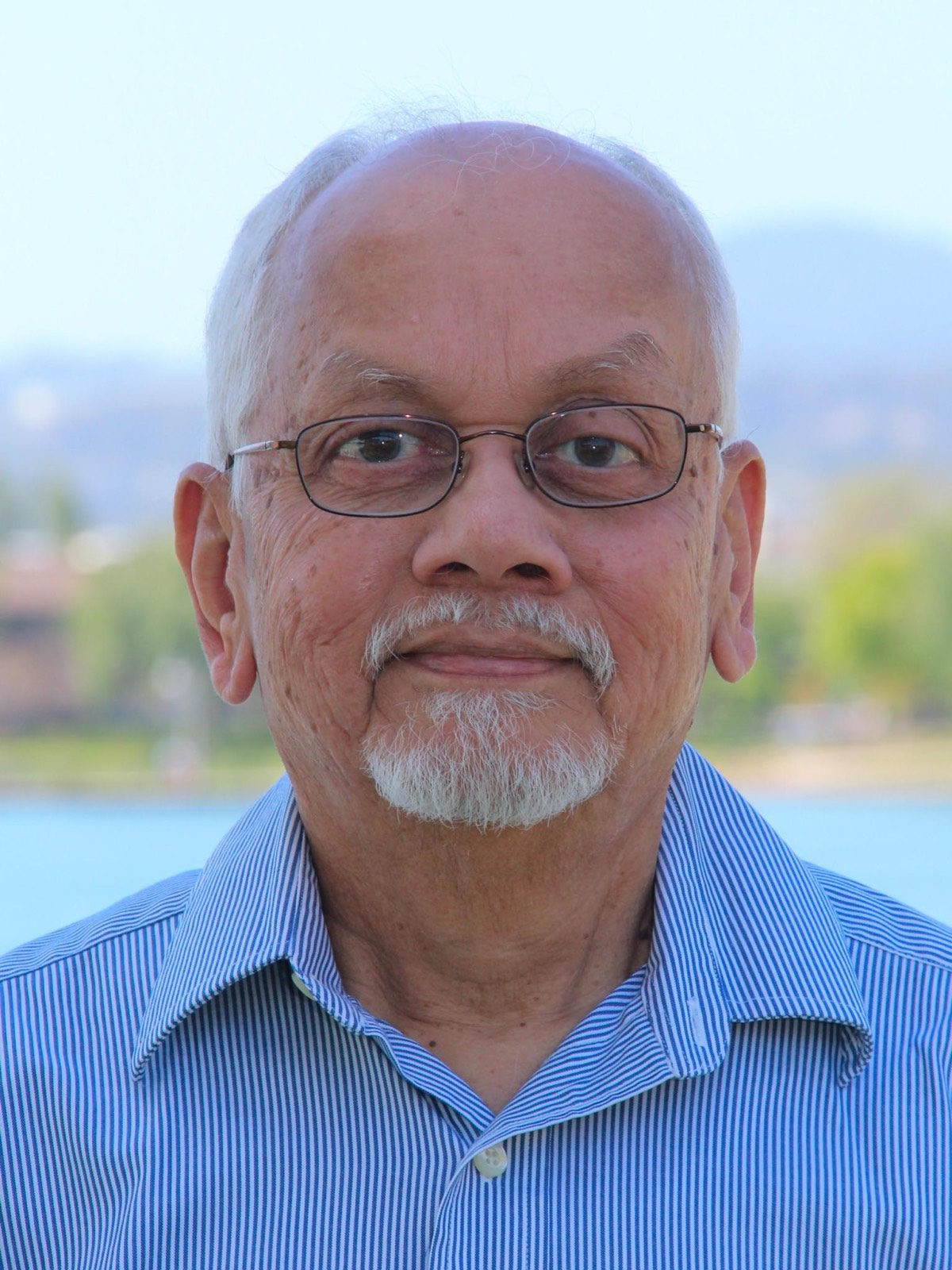
Acharya Arumuganathaswami
Acharya Arumuganathaswami delivered the Graduation Address at HSCI's Sixth Graduation Gala as Guest of Honor.

2024 Karma Yoga Honoree: Mihir Meghani, MD
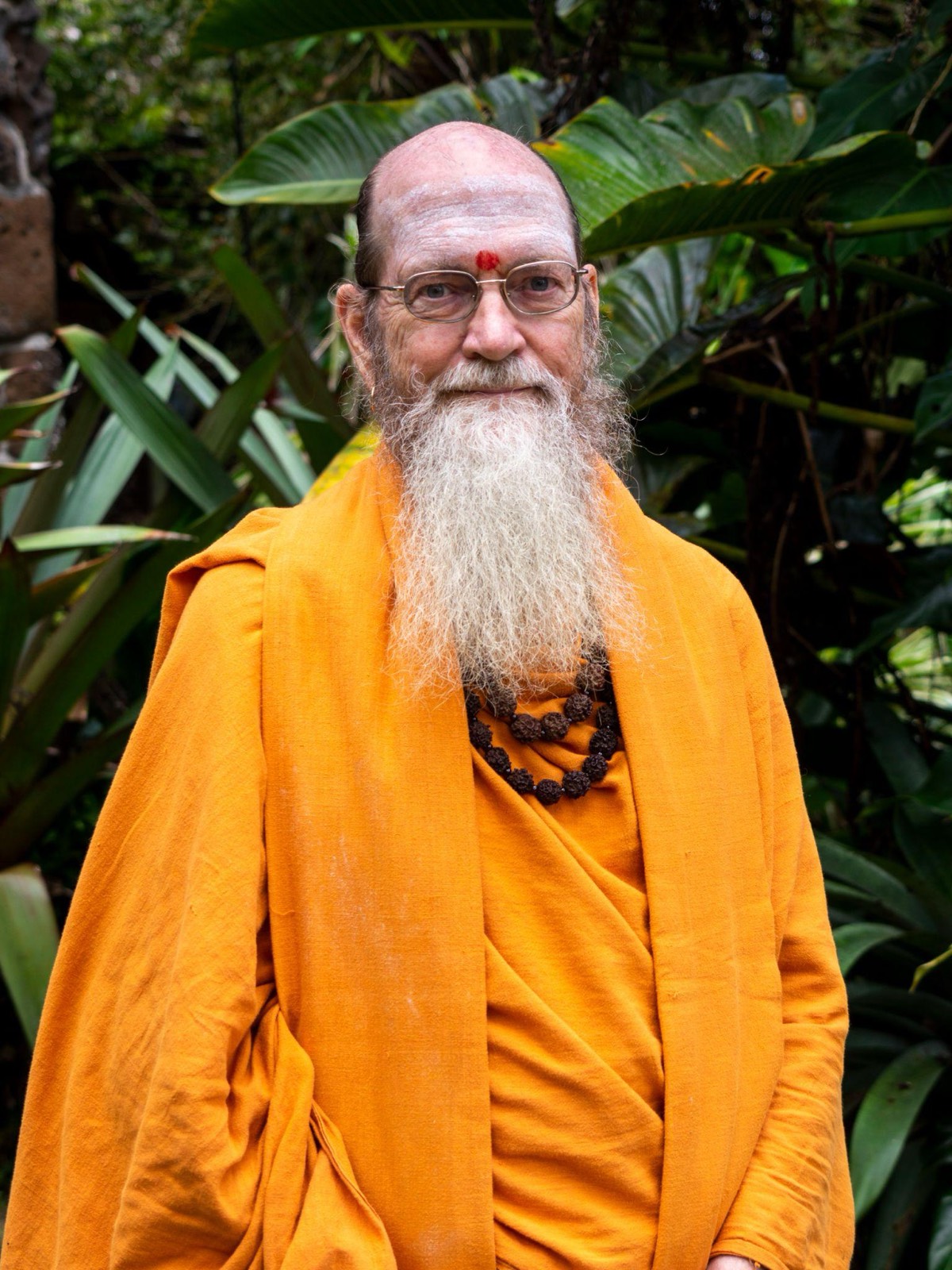
Mihir Meghani, MD
In recognition of his long-standing support of Hindu values and tradition by way of the founding and growth of the Hindu American Foundation (HAF).

2024 Karma Yoga Honoree: Mukund Acharya, PhD
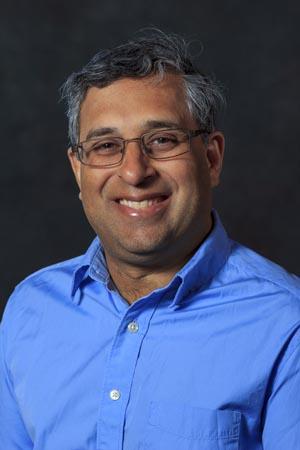
Mukund Acharya, PhD
In recognition of his pioneering initiatives to care for the elderly & people dealing with serious illness, by helping build Sukham, HSCI and Sandhya's Touch as novel community service organizations.
Meet the 8 Pioneers
Global Hindu Interreligious Chaplaincy Pathway

Meet the 8 Pioneers of Global Hindu Chaplaincy
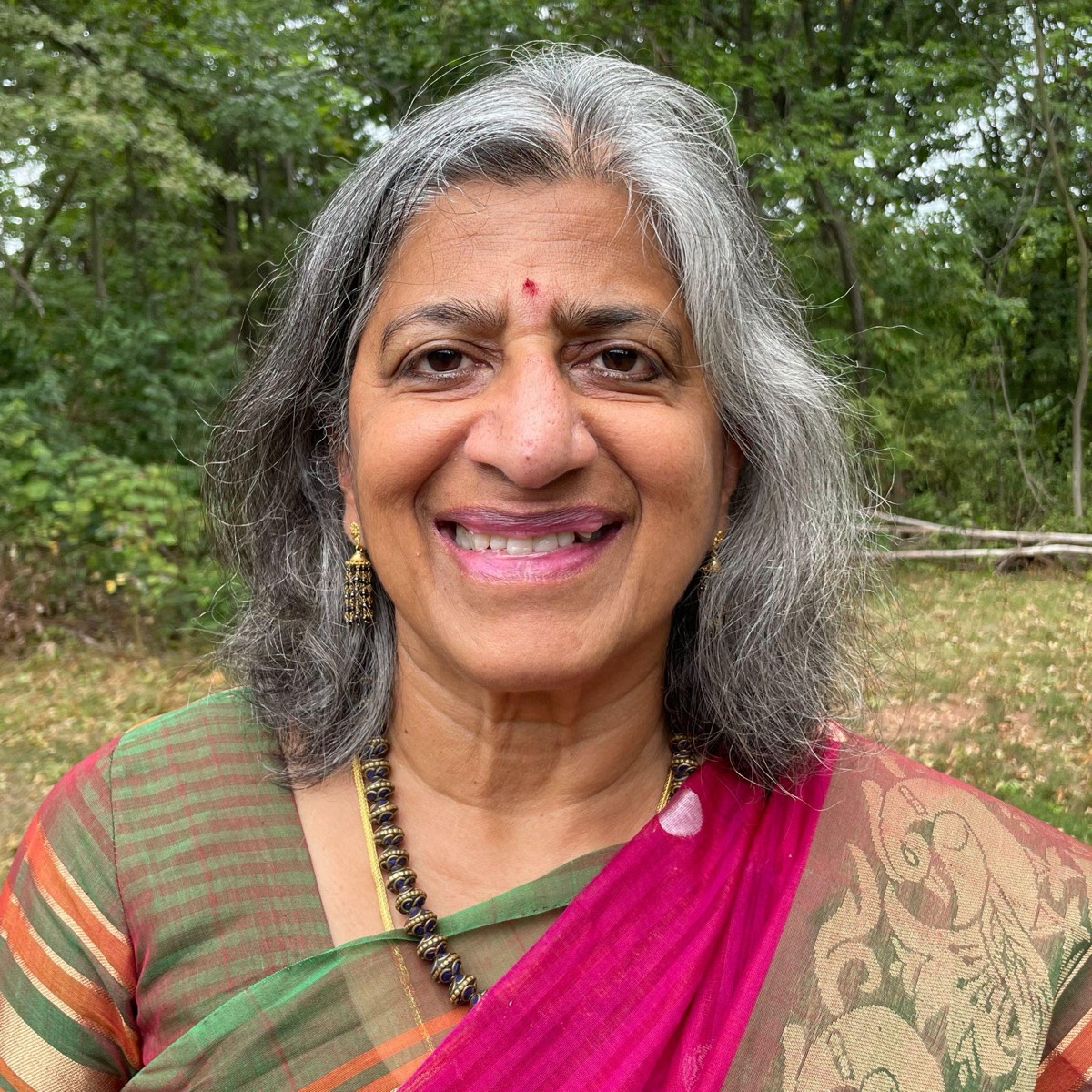
ICP Graduation - Neeti Soota with Gaurav Rastogi and Dr Kamal Abu-Shamsieh
These eight scholars have completed the requirements to become Hindu chaplains through the Interreligious Chaplaincy Program (ICP) at the Graduate Theological Union (GTU). They are the trail blazers in our quest to build a global network of spiritual care providers: Usha Narasimhan (MBA, US), Neeti Soota (MS, US), Nisha Singh (PhD, Australia), Madhuri Velagala (PhD, Australia), Varsha Kaushal (PhD, US), Bindu Gupta (MA, US), Jag Gossai (MS, Canada), and Smriti Murali Krishna (PhD, Australia).

Our deepest gratitude to the Graduate Theological Union (GTU) and the Motwani-Jadeja Foundation (MJF) for their support for this pathway.

HSCI
Congratulations to the HCP 2024 Graduates

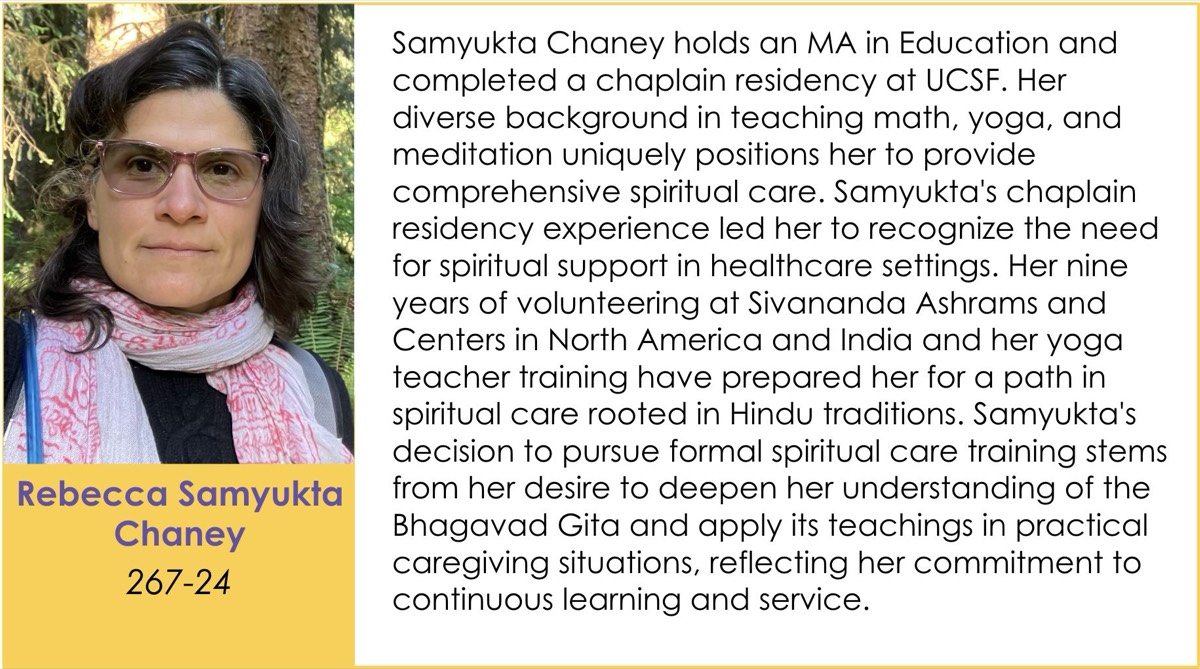
Swathi Anantha (266-24)

Swathi Anantha
Swathi Anantha holds a Master's in Public Health from the University of Texas, Houston, and a Bachelor's in Spanish & Biology from Austin College. Her experience in adolescent health research and public school teaching led her to recognize the need for spiritual care to address human behavior and health holistically. Swathi's involvement with Chinmaya Mission, including completing a 2-year residential Vedanta course and serving as a spiritual guide, has prepared her for a path in Hindu chaplaincy.
RC
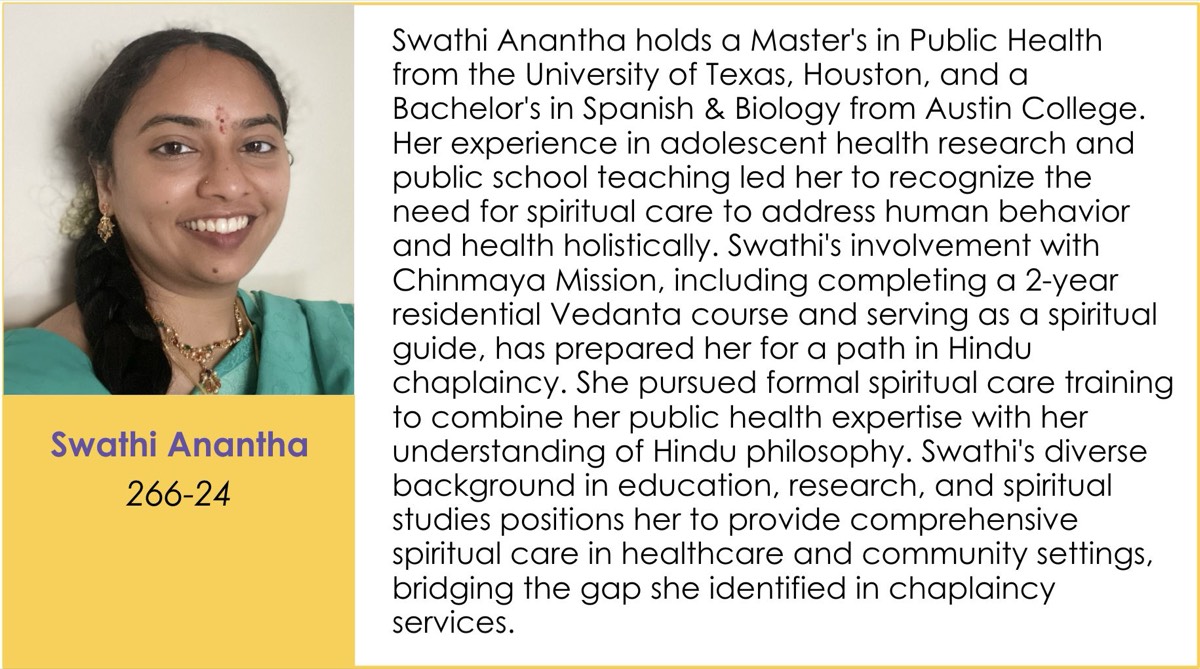
Rebecca Samyukta Chaney

Rebecca Samyukta Chaney (267-24)

Samyukta Chaney holds an MA in Education and completed a chaplain residency at UCSF. Her diverse background in teaching math, yoga, and meditation uniquely positions her to provide comprehensive spiritual care. Her nine years of volunteering at Sivananda Ashrams and Centers in North America and India and her yoga teacher training have prepared her for a path in spiritual care rooted in Hindu traditions.

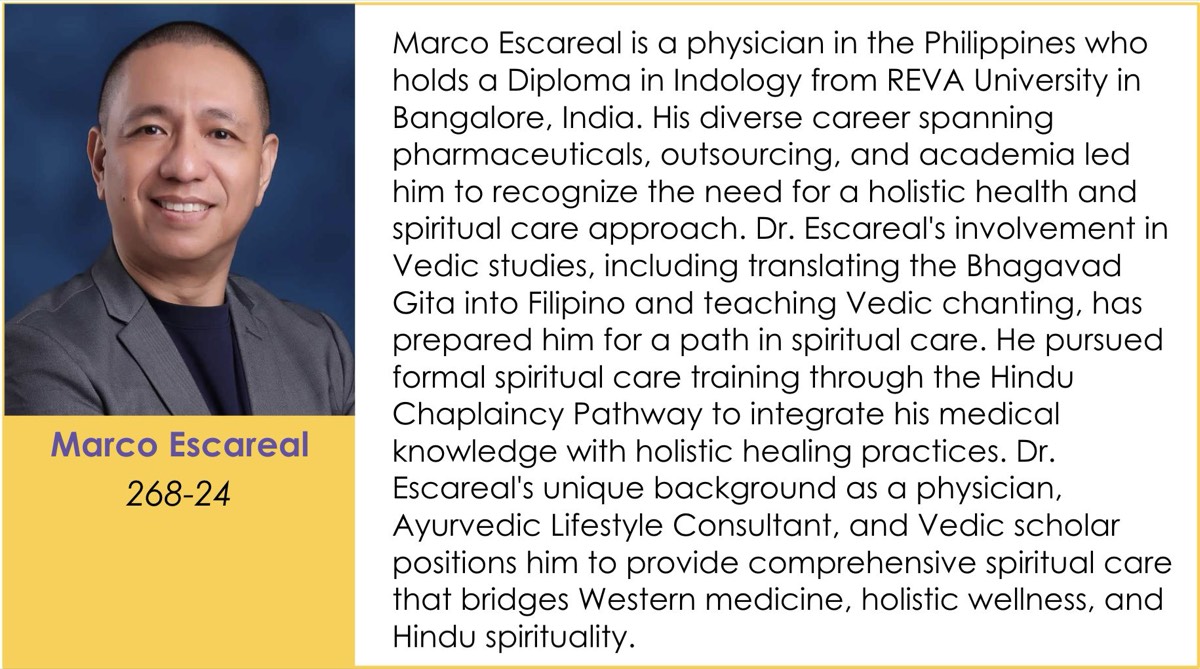
Marco Escareal (268-24)

Marco Escareal
Marco Escareal is a physician in the Philippines who holds a Diploma in Indology from REVA University in Bangalore, India. His diverse career spanning pharmaceuticals, outsourcing, and academia led him to recognize the need for a holistic health and spiritual care approach. Dr. Escareal's involvement in Vedic studies, including translating the Bhagavad Gita into Filipino and teaching Vedic chanting, has prepared him for a path in spiritual care.

We are thrilled to support this pioneering initiative. By integrating Hindu spiritual care into various sectors, we can address critical issues of mental health and well-being in our communities. These chaplains embody the compassionate and inclusive spirit of the Hindu tradition, and we believe their work will profoundly impact society.

Asha Jadeja-Motwani — Donor and Founder, Motwani-Jadeja Foundation and the MJF Hindu Chaplaincy Fellowship
HCP Graduate

Zachary Ginder (269-24) & Sharad Patel (271-24)

Zachary Ginder holds a Doctorate in Clinical Psychology and a Master's in Social Work. His work as a pediatric healthcare administrator and Chair of the Riverside County Children and Families Commission led him to recognize the need for spiritual care in healthcare and community settings. Sharad Patel came to the United States from Tanzania to study in Silicon Valley. For 25 years, Sharad focused on creating tech solutions for healthcare. He has been informally serving as a Chaplain in his community, where he serves terminal patients and families with last rites guidance.

The Interreligious Chaplaincy Program (ICP) at the Graduate Theological Union (GTU) welcomes students from all backgrounds, especially minorities, to explore and study in an affirming environment that celebrates diversity and pluralism.

Kamal Abu-Shamsieh, Ph.D. — Director, Interreligious Chaplaincy, GTU, Berkeley, CA
HCRC, Personal Journeys and Developments

The Hindu Chaplaincy Resource Center (HCRC)

HCRC is the serving arm of the Hindu Spiritual Care Institute (HSCI), providing a beacon of support and knowledge for compassionate spiritual guidance across religious boundaries. We offer authentic, contemporary information and guidance on Hindu chaplaincy, education, training, and practice to a global audience. Functions of HCRC include: Library and Archive, Kutumba Journal, TrayaCare Platform for tele-chaplaincy, Mentoring & Guidance, and Membership and Access to knowledge assets including books, papers, journals, case studies, interfaith chaplaincy protocols, and materials on Hindu traditions.
TrayaCare Platform

Spiritual Care Where and When Needed

Everyone needs access to Spiritual Care, but current models of in-person engagement mean that these services are limited in time, space, and demographics. Imagine getting a trained counselor to work with you wherever you are, in your language, and at any time of the day! HSCI dreams of making spiritual care available worldwide by deploying chaplains and trained service providers. We have developed a technology platform to make spiritual care support available to anyone with a smartphone and an internet connection. We are calling this TrayaCare because the cure for traya-tapa (the threefold affliction) will bring relief to the body, mind, and spirit.

Anyone who needs help can scan a QR code with their phone. Once we understand their needs, we assign them a service provider sensitive to their cultural and language needs. This is a highly reliable, secure, and confidential space for conversations that is available without downloads or advanced technical know-how.

Kailash Joshi & Gaurav Rastogi
200

HSCI Centers for Learning and Serving

The rapid growth and success of HSCI reflect the increased worldwide awareness of the importance of spiritual care. In its sixth year, the twenty-four-session CHT course equips professionals from all fields to serve their communities in volunteer positions at various religious and interfaith institutions. The two cornerstones of HSCI are Karma yoga, or selfless service, and Vasudhaiva Kutumbakam, a worldview of collective well-being. Over the last several years, HSCI has judiciously developed its academic programs and is now applying for accreditation as a global training institution.
Personal Journeys

My Journey to Hindu Chaplaincy through HSCI

I am honored to be one of the initial cohort of inter-religious Hindu chaplains anywhere. A couple of years ago, I never thought I would embark on this journey in a society so different from where I started my life. My great-grandparents served as indentured laborers in South Africa in the 1880s. As a fourth-generation Indian out of India, I have no direct personal links with India. Yet, the flame of Hindu Dharma passed down from my ancestors enabled us to thrive despite the apartheid regime. Armed with basic knowledge and confidence, I could offer spiritual care in the aged care sector.

Where else can you have five generations of Hindus from six countries in the same class with the same purpose of learning to serve the community? The growth of formal Hindu chaplaincy programs and pathways to recognition and certification will allow us to participate in and support the Hindu diaspora in all walks of life.

Nisha Singh, PhD
Feature

The Hindu Kit of Tools

Life, as we know, isn't always smooth sailing. At times, we face adversities that test our willpower and spirit. In Hindu philosophy, these adversities are often called the threefold miseries, called "Trayatapa," and we have a variety of methods to cope with and heal from misfortune caused by supernatural causes, physical ailments, and mental or spiritual anguish. The Hindu tradition offers holistic approaches: Ayurveda for restoring balance within the body, Yoga and Pranayama for resetting the body and mind, and Spiritual Care through community companionship and support during difficult times.

Understanding and embracing these ancient traditions can bring balance and resilience to our lives, no matter where we are. HSCI emphasizes the importance of establishing support systems through modern technology.

Gaurav Rastogi

My Journey from Science to Spiritual Care

From a young age, I was always fascinated by science and spirituality. Driven by my passion for genetics, I pursued a PhD in molecular biology in 2000, where I had the opportunity to support patients in palliative care and end-of-life support activities. The Hindu Council of Australia endorsed me as a chaplain within the tertiary education sector, and the Vishwa Hindu Parishad endorsed me to become a chaplain within the Australian Defence Force (ADF). After a year-long selection, I was appointed the first female Hindu chaplain in the ADF Army.

I was introduced to HSCI by a graduate and decided to enroll in the CHT program. HSCI's CHT program was an eye-opener for me. Without a local organization to interact with and find answers to my questions, the opportunity to engage with pioneers in the field through the CHT program has been invaluable as I embark on my journey as an ADF chaplain.

Smriti Murali Krishna, PhD — First Hindu Female Chaplain, Australian Defence Force
YT

Yoga Therapy for Wellness

While all yoga is potentially therapeutic and healing, yoga therapy is the specific application of yogic tools to address an individual's physical, mental, and emotional needs. A yoga therapy session goes much further because it is customized for the individual. Yoga therapy can complement physical, occupational, and psychotherapy and more. Yoga therapy clients heal themselves by learning and practicing the tools that can be highly beneficial throughout a lifetime.
HSCI Success Factors

Built By the Community, For the Community, From the Community

The all-volunteer HSCI team has developed a strong culture of corporate management and selfless community service, supported by due processes and succession planning in these areas: Governance — Sound governance under an experienced Board of Directors. Leadership — Management & functional leadership drawn from HSCI graduates. Partnerships — Strong partnerships with academic institutions, interfaith best practices, and country mentors. Network — Emerging global network of Hindu chaplains and counselors connected through the HCRC.

As one of the few full-time Hindu chaplains working in US higher education and the Chair of NAHCA, I have witnessed the tremendous value of our Hindu practices and philosophies towards supporting individual human flourishing. We need more Hindu chaplains; their heart-centered spiritual care will help not only individuals but strengthen, inspire and invigorate our communities.

Asha C Shipman, PhD — Chair, North America Hindu Chaplains Association (NAHCA), Director of Hindu Life, Yale University
Editorial Board

Kailash Joshi, Gaurav Rastogi, Lakshmi Srinivasan

journal@hinduci.com

← All Issues

Your gift — no matter what size — supports the training of Hindu chaplains worldwide

Support Hindu Chaplaincy
Support Us