Dharma-Informed Literacies in the Age of Intelligence
As we navigate the Age of Intelligence, technological advancements are creating unprecedented forms of functional illiteracy. Drawing from Hindu spiritual traditions and contemporary insights, this paper introduces the 4S Framework — Social, Spiritual, Sales, and Software Literacy — replacing the former 3Rs of the Industrial Age. Through the parables of Bhasmasura, the poetry of Kabir, and the cinema of Satyajit Ray, we trace the recurring pattern of power without wisdom and propose a dharma-informed path toward human flourishing in partnership with artificial intelligence.
Great power, it turned out, required the ability to learn how to take on greater responsibility.
On the parable of BhasmasuraBhasmasura's Unlimited Power
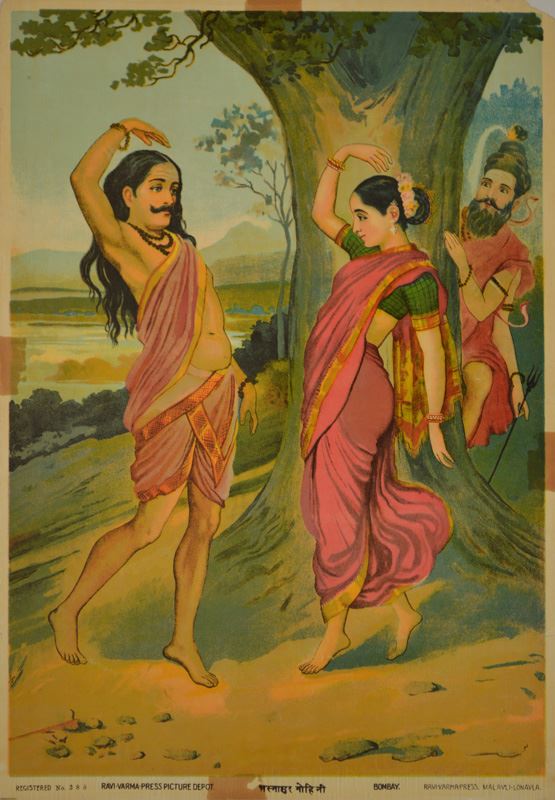
Mohini and Bhasmasura, Raja Ravi Varma Press
The parable of Bhasmasura, from the Skanda Purana, frames the central dilemma of our technological era. An ambitious asura performs severe penance to gain a divine boon from Lord Shiva: the power to turn anything to ash with the mere touch of his hand. The moment the power was bestowed, Bhasmasura's first impulse was to test it on Shiva himself.
The crisis was resolved not through greater power but through recursive wisdom. Vishnu, disguised as Mohini, challenged Bhasmasura to a dance — and in demonstrating his mastery, the asura placed his hand upon his own head. The threat was neutralized not by external force but by internal understanding.
We have become a Bhasmasura civilization — wielding unprecedented technological power while lacking the wisdom to use it properly. Our AI systems can read faster than any scholar, write more prolifically than any author, and calculate more accurately than any mathematician. We deploy AI to replace human connection, automate away human judgment, and optimize for metrics that hollow out meaning.
Kabir's Two-and-a-Half Letters of Love
ढाई अक्षर प्रेम के, पढ़े सो पंडित होये
"Whoever reads the two-and-a-half letters of love becomes a true scholar"
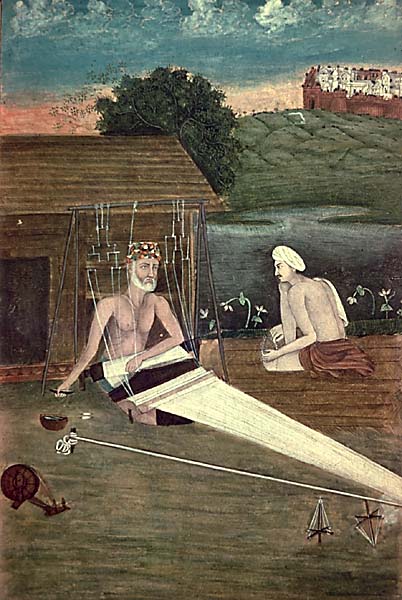
Kabir at the loom, 17th century painting
The phrase "dhai akshar" refers to the Hindi word prem (प्रेम) — love — which in Devanagari contains two full letters and one half-letter. Kabir was pointing to something profound: all the scriptural learning, all the theological debates, all the accumulated knowledge of the ages meant nothing without the fundamental literacy of love.
This is not literacy as information processing, but literacy as relationship — the ability to read the living text of human experience with wisdom, compassion, and discernment. It is the capacity to perceive what lies beneath the surface, to respond to deeper needs and longings, to create spaces where authentic connection can flourish.
This relational literacy cannot be automated or optimized. No algorithm can replicate the quality of presence that allows one person to truly see and understand another.
Shatranj ke Khiladi: The Illiteracy of Stagnation

Shatranj ke Khiladi (The Chess Players) — Satyajit Ray, 1977
In Satyajit Ray's 1977 masterpiece, two Nawabi aristocrats — supreme masters of Persian poetry, elaborate courtesies, and refined cultural discourse — perfect their chess games while the British East India Company systematically dismantles their civilization around them.
Their tragedy was not lack of intelligence or sophistication. Their entire framework for understanding the world had become counterproductive. They were fluent in the idiom of a dying world but illiterate in the idiom of the emerging one.
Like these chess players, many of us have achieved mastery within idioms that are becoming rapidly obsolete. A marketing professional who has mastered compelling narratives may not understand how AI-generated content reshapes expectations. A teacher who has perfected classroom management may be unprepared for AI tutors providing personalized instruction at scale. We risk perfecting competencies while the world transforms around us.
The 4S Framework
The traditional 3Rs of literacy — Reading, wRiting, aRithmetic — served the Industrial Age. Machines now surpass us at all three. The 4S Framework redefines literacy around our capacity for connection:
Connecting People to People
The capacity to foster genuine human-to-human relationship in an age where AI increasingly simulates connection. Perceiving what someone isn't saying. Creating psychological safety. Community weaving.
Connecting People to Purpose
Without this literacy, we risk becoming what Byung-Chul Han calls "the burnout society" — endlessly productive but profoundly empty. Values clarification. Contemplative practice. Finding the "why."
Connecting People to Value
The capacity to recognize, create, and communicate genuine worth. Distinguishing real needs from manufactured wants. Right livelihood. Authentic persuasion over manipulation.
Connecting People to Technology
Understanding how AI systems make decisions and affect human experience. Algorithmic awareness. Digital sovereignty. Shaping systems rather than being shaped by them.
These literacies are not separate skills but interconnected capacities emerging from a shared foundation: the recognition that human flourishing depends on our ability to create authentic relationships with people, purpose, value, and the systems that shape our world.
The age of intelligence need not be the age of human obsolescence. It can be the age when humans finally learn to be fully human — not in opposition to our technological capabilities but in conscious relationship with them.
Gaurav RastogiThe Integration
While each literacy can be developed independently, their real power emerges through integration:
- Social literacy without spiritual grounding can become manipulative networking
- Spiritual practice without social engagement can become self-indulgent escapism
- Value creation without technological understanding can become irrelevant idealism
- Technical skills without ethical foundation can become destructive cleverness
The integration creates dharmic competence — the capacity to act skillfully in service of human flourishing across all domains. It is relational rather than extractive, adaptive rather than rigid, holistic rather than reductionist.
Beyond Bhasmasura's Ash
The path forward requires neither rejecting technology nor surrendering to it, but learning to dance with it from a place of grounded human wisdom. The solution to the challenges posed by AI is not to develop more powerful AI — just as the solution to Bhasmasura's destructive capacity was not to grant him even greater powers.
The invitation is clear: to move beyond the functional illiteracy of disconnection toward the dharmic literacy of conscious relationship. To become the kind of humans who can wield the power of gods with the wisdom of sages — not perfect beings, but conscious ones, committed to the ongoing cultivation of literacies that allow technology to serve rather than subvert the deepest aspirations of the human heart.
Keywords: dharma, literacy, artificial intelligence, 4S framework, Hindu tradition, Bhasmasura, Kabir, spiritual care, human agency, Age of Intelligence
Citation: Rastogi, G. (2025). Dharma-Informed Literacies for Human Agency in the Age of Intelligence: The 4S Framework. Conference paper, Hindu Spiritual Care Institute.
Related: Rastogi, G., Joshi, M., & Klein, J.R. (2022). Global Business in the Age of Destruction and Distraction. Oxford University Press.
Status: Conference paper. For inquiries, contact gaurav@hinduci.org

Gaurav Rastogi
Board Member, Hindu Spiritual Care Institute. Visiting Faculty, IIM Ahmedabad and Ashoka University. Board Trustee, Graduate Theological Union. Author of Global Business in the Age of Destruction and Distraction (Oxford University Press, 2022).