Spiritual Care Tools from the Hindu Tradition
This research explores the comprehensive toolkit of spiritual care practices derived from Hindu traditions, offering a holistic approach to addressing life's challenges. Centered around the ancient concept of tāpatraya — the threefold miseries — the study examines how practices such as Vedic astrology, Ayurveda, yoga, meditation, and devotional rituals can be effectively integrated into modern spiritual care contexts, enhancing cultural competence for Hindu populations while offering insights that benefit individuals from diverse backgrounds.
Peer-reviewed · Published 27 August 2026
This paper appears in the Journal of Pastoral Care & Counseling (SAGE). Read it at doi.org/10.1177/15423050261483268.
The Threefold Miseries
"There are things which are within our power, and there are things which are beyond our power," said the Stoic philosopher Epictetus. The Hindu concept of tāpa-traya presents a more nuanced perspective, categorizing the full spectrum of human suffering into three distinct types — each requiring a different approach and set of tools.
Situational
Events and circumstances beyond our immediate control — natural disasters, societal upheavals, personal tragedies, climate change, economic crises, and geopolitical strife.
Physical
Physical maladies and environmental challenges — bodily ailments, environmental pollutants, bad food choices, the natural aging process, and the need for holistic health.
Mind & Spirit
Inner struggles — depression, anxiety, grief, existential despair, the search for meaning, the loneliness epidemic, and disconnection from purpose and community.
This framework acknowledges that human suffering comes in various forms, each requiring a different approach. The Hindu spiritual toolkit offers a comprehensive, time-tested system for navigating all three.
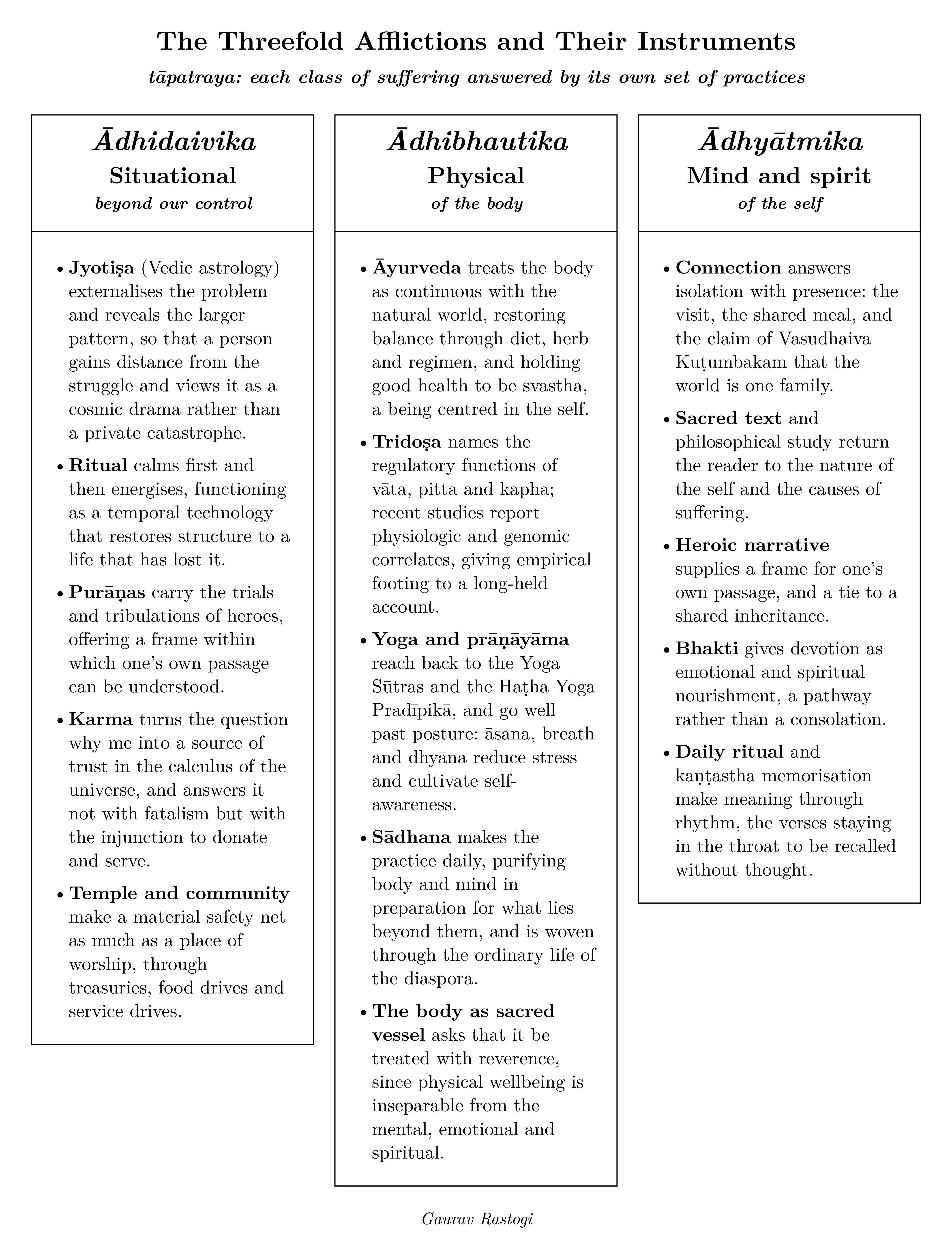
Diagram by Gaurav Rastogi. Open full-size image.
Tools for Situational Afflictions
Vedic Astrology (Jyotiṣa)
Vedic astrology and Hindu spiritual tradition have been intertwined for millennia. Its particular utility in modern spiritual care lies in its ability to externalize problems and reveal larger life patterns. By discussing planetary positions and transits as external influences, individuals can gain psychological distance from their struggles — viewing them as characters in a cosmic drama rather than being fully immersed in difficulties. This process of externalization can function similarly to narrative therapy techniques.
Engagement in Rituals
Rituals serve multiple functions in addressing life's challenges. They instill events with a sense of sacredness and meaning while providing structure and agency during periods of disruption. As Byung-Chul Han observes, rituals function as a form of "temporal technology," enabling individuals to create a sense of belonging and routine in the world.
Karma and Reincarnation
Karma, often misunderstood as fatalistic, is ultimately empowering. It affirms our ability to shape our future through our choices and actions. This understanding parallels Viktor Frankl's account of the freedom that survives even captivity: "the last of the human freedoms — to choose one's attitude in any given set of circumstances, to choose one's own way."
Community Support and Temples
Temples serve as more than places of worship — they are cultural repositories and safety nets, offering tangible assistance such as food, shelter, and financial aid to community members in crisis. They foster a sense of belonging and practical support during life's most challenging moments.
Everything can be taken from a man but one thing: the last of the human freedoms — to choose one's attitude in any given set of circumstances, to choose one's own way.
Viktor Frankl, Man's Search for MeaningTools for Physical Afflictions
Ayurveda
The traditional Hindu system of medicine, rooted in balancing the three doṣa-s — vāta, pitta, and kapha — through customized dietary, herbal, and lifestyle interventions. The traditional definition of good health, svastha, translates to "being centered in the self," implying a dynamic balance achieved through balanced inner and outer life practices. Recent experimental studies have begun to empirically validate the concept of tridoṣa, demonstrating potential physiologic and genomic correlates.
Yoga and Prāṇāyāma
These practices go far beyond the pop-culture fitness routines found on social media. Yoga, dhyāna (meditation), and prāṇāyāma are ways of life that cultivate connection and union between an individual and their world and the Divine. They work synergistically with Ayurveda to balance the body's subtle energy channels and promote mental clarity, emotional equilibrium, and physical well-being.
Honoring the Body as Sacred
Central to the Hindu approach is the belief in honoring the body as a sacred vessel. This perspective encourages individuals to treat their bodies with reverence, recognizing that physical well-being is intimately connected to mental, emotional, and spiritual well-being.
Tools for Mental and Spiritual Afflictions
Meaningful Human Connection
Rooted in the principle of Vasudhaiva Kuṭumbakam ("the world is one family"), the Hindu tradition emphasizes that seeking opportunities for meaningful connection is paramount in times of distress. Practices like satsang (spiritual fellowship), kīrtan (devotional chanting), and shared storytelling can dissolve feelings of isolation and reaffirm our essential wholeness.
Sacred Texts and Philosophical Study
For many Hindus, studying sacred texts is a core practice for mental well-being. As Swami Vivekananda described, sacred scripture is the "collected treasury of spiritual laws discovered by different people at different times." The Bhagavad Gītā and upaniṣad-s offer insights into the nature of the Self, the causes of suffering, and the path to lasting peace and mokṣa (liberation).
Heroic Narratives and Mythology
Stories of overcoming tremendous challenges serve multiple purposes: providing inspiration during difficult times, offering a framework for understanding one's life journey, and connecting individuals to a shared cultural heritage. Many Hindus memorize fragments of these verses, such as the Hanumān Chālīsā, and chant them for strength and courage.
Bhakti (Devotion)
Devotional songs, hymns, and kirtan provide emotional and spiritual nourishment, foster a sense of connection to the Divine, offer comfort, and create pathways toward spiritual progress. These practices are recognized as one of the primary pathways in Hindu tradition.
Daily Rituals and Practice
The structure provided by daily, monthly, and annual rituals cultivates a greater sense of meaning and flow. The Sanskrit word for memorization is kaṇṭastha — which means that the verses stay in the throat and can be recalled without using thoughts. These memorized verses serve as the matrix within which to conduct the world's affairs.
The Hindu approach to death, encapsulated in the traditional farewell "Om Shanti, Sadgati Praptirastu" — May there be peace, may the departed travel to an auspicious destination — reflects a peaceful acceptance of death as a transition rather than an endpoint.
Rastogi & Ginder, Spiritual Care Tools in the Hindu Tradition (2026)Implications for Spiritual Care
This framework offers spiritual care providers — both Hindu and non-Hindu — a structured, evidence-informed approach to understanding and supporting individuals through life's challenges. The underlying principles of the Hindu approach — acceptance of life's cyclical nature, attunement to natural rhythms, and emphasis on human connection — hold broader relevance for the entire field of spiritual care.
Keywords: Hindu spiritual care, holistic wellness, cultural competence, Ayurveda, yoga, mindfulness, interfaith dialogue, tāpatraya
Citation: Rastogi, G., & Ginder, Z. (2026). Spiritual Care Tools from the Hindu Tradition: A Holistic Approach to Addressing Life’s Challenges. Journal of Pastoral Care & Counseling. Advance online publication, 27 August 2026. doi.org/10.1177/15423050261483268
Full paper: Read at the Journal of Pastoral Care & Counseling · For inquiries, contact admissions@hsciglobal.org
Gaurav Rastogi
Technology executive and meditation instructor with nearly thirty years integrating Eastern wisdom with modern practice. Author of three business books.

Zachary Ginder
Doctor of clinical psychology specializing in integrative approaches to mental health. Researches the intersection of traditional spiritual practices and contemporary healing modalities.