This is a Diwali talk by Gaurav Rastogi. Diwali is the Hindu festival of lamps. The talk takes up what Hindus do on Diwali: they celebrate Rāma, a prince of the epic Rāmāyaṇa who gave up a kingdom; they worship Lakṣmī, goddess of wealth, and play cards; and they light small lamps. Each slide appears with the words spoken over it, a short note, and the Sanskrit it quotes, in Devanagari and in Roman letters, with its source. The verses in full follow the slides. Click through the slides or download all of it as a PDF.
Tonight we do three things. We celebrate a man who gave up a kingdom. We worship the goddess of wealth, and then we bring out the cards. And on the darkest night we can find, we light one small lamp.
Diwali comes from the Sanskrit dīpāvali, a row of lamps: dīpa is a lamp, āvali a row.
दीपावलि, dīpāvali.
Rāma was twenty-five, not much older than you, on the day he was to be crowned. Before that day ended the crown was gone, because his father had to honor an old promise: fourteen years in the forest. Rāma went to say goodbye. And his father, the king, the man who made the promise, said: I was a fool. Tie me up, and be king yourself, today.
Rāma is the hero of the Rāmāyaṇa, the Sanskrit epic of Vālmīki. His father is Daśaratha, king of Ayodhyā, and the promise was to Kaikeyī, one of his queens, who held him to it. Nigṛhya mām: seize me, restrain me.
अहं राघव कैकेय्या वरदानेन मोहितः
अयोध्यायास्त्वमेवाद्य भव राजा निगृह्य माम्
ahaṃ rāghava kaikeyyā varadānena mohitaḥ
ayodhyāyās tvam evādya bhava rājā nigṛhya mām
Rāmāyaṇa 2.31.23
Vālmīki, Rāmāyaṇa, Baroda critical edition. His age as Sītā gives it, 3.45.10.
Nobody on earth would have blamed him. Rāma said: you rule, I will go, I won't make a liar of you.
Na me kāryaṃ tvayānṛtam: I won’t have you made a liar.
भवान्वर्षसहस्राय पृथिव्या नृपते पतिः
अहं त्वरण्ये वत्स्यामि न मे कार्यं त्वयानृतम्
bhavān varṣasahasrāya pṛthivyā nṛpate patiḥ
ahaṃ tv araṇye vatsyāmi na me kāryaṃ tvayānṛtam
Rāmāyaṇa 2.31.25
So the old man asked for something smaller. All right, go. But not tonight, son. Stay one night. Eat well. See your mother. Leave in the morning.
The father says go, śreyase, for your good (2.31.26). In the next verse he asks for one night, with everything Rāma could want, sarvakāmais.
अद्य त्विदानीं रजनीं पुत्र मा गच्छ सर्वथा
मातरं मां च संपश्यन्वसेमामद्य शर्वरीम्
तर्पितः सर्वकामैस्त्वं श्वःकाले साधयिष्यसि
adya tv idānīṃ rajanīṃ putra mā gaccha sarvathā
mātaraṃ māṃ ca saṃpaśyan vasemām adya śarvarīm
tarpitaḥ sarvakāmais tvaṃ śvaḥkāle sādhayiṣyasi
Rāmāyaṇa 2.31.27
Not tonight. You know that voice. You will hear it all your life, and it will always sound like someone who loves you. Most nights it will be your own.
A father is asking for one more night with his son. Rāma’s answer comes two verses later, at 2.31.29.
Rāma, in pain, told him: who will give me tomorrow what I could have today? I choose to go.
Vṛṇe is “I choose”. Rāma chooses leaving, apakramaṇam, over sarvakāmair, everything he could want: the word his father had just used.
प्राप्स्यामि यानद्य गुणान्को मे श्वस्तान्प्रदास्यति
अपक्रमणमेवातः सर्वकामैरहं वृणे
prāpsyāmi yān adya guṇān ko me śvastān pradāsyati
apakramaṇam evātaḥ sarvakāmair ahaṃ vṛṇe
Rāmāyaṇa 2.31.29
Most of you know the next part, because you have done it, at a curb, with your parents getting smaller in the mirror. His father and mother came out on foot behind the chariot, his mother running, calling his name. The king shouted: stop. Rāma told the driver: go, go. And when my father blames you, say you did not hear.
Sumantra the driver: his heart was as if between two wheels.
तिष्ठेति राजा चुक्रोष याहि याहीति राघवः
सुमन्त्रस्य बभूवात्मा चक्रयोरिव चान्तरा
tiṣṭheti rājā cukroṣa yāhi yāhīti rāghavaḥ
sumantrasya babhūvātmā cakrayor iva cāntarā
Rāmāyaṇa 2.35.33
Rāma’s words to the driver are the next verse, 2.35.34.
The son who would not make a liar of his father told the driver to lie.
Nāśrauṣam, “I did not hear”: Rāma tells the driver to say this to the king.
नाश्रौषमिति राजानमुपालब्धोऽपि वक्ष्यसि
चिरं दुःखस्य पापिष्ठमिति रामस्तमब्रवीत्
nāśrauṣam iti rājānam upālabdho ’pi vakṣyasi
ciraṃ duḥkhasya pāpiṣṭham iti rāmas tam abravīt
Rāmāyaṇa 2.35.34
That first night he lay on the ground and said to his brother: my father will sleep badly tonight. I think this is the end of him. Let no mother ever bear a son like me. And he sat in the dark with his face wet. His father did not survive it.
Aśrupūrṇamukho: his face full of tears. The brother is Lakṣmaṇa.
ध्रुवमद्य महाराजो दुःखं स्वपिति लक्ष्मण
dhruvam adya mahārājo duḥkhaṃ svapiti lakṣmaṇa
Rāmāyaṇa 2.47.6
मा स्म सीमन्तिनी का चिज्जनयेत्पुत्रमीदृशम्
mā sma sīmantinī kā cij janayet putram īdṛśam
Rāmāyaṇa 2.47.21
अश्रुपूर्णमुखो रामो निशि तूष्णीमुपाविशत्
aśrupūrṇamukho rāmo niśi tūṣṇīm upāviśat
Rāmāyaṇa 2.47.27
“The end of him”: Rāmāyaṇa 2.47.14. His father’s death: 2.58.57.
The Kaṭha Upaniṣad says two things come to every person, śreyas and preyas, the good and the pleasant. They arrive together, and the steady one walks around them and tells them apart. This one we call Maryādā Puruṣottama, the best of men, who sets the line and keeps it, and tonight we light lamps for his coming home.
Maryādā Puruṣottama is Rāma’s title. For many Hindus Diwali marks his return to Ayodhyā after the fourteen years. The Upaniṣad’s verb, vṛṇīte, chooses, is the verb Rāma used, vṛṇe, I choose.
श्रेयश्च प्रेयश्च मनुष्यमेतस्तौ संपरीत्य विविनक्ति धीरः
श्रेयो हि धीरोऽभि प्रेयसो वृणीते प्रेयो मन्दो योगक्षेमाद्वृणीते
śreyaś ca preyaś ca manuṣyam etas tau saṃparītya vivinakti dhīraḥ
śreyo hi dhīro ’bhi preyaso vṛṇīte preyo mando yogakṣemād vṛṇīte
Kaṭha Upaniṣad 1.2.2
The Upaniṣads are philosophical texts at the close of the Vedas, the oldest Hindu scriptures.
Why does anyone choose the pleasant? The Upaniṣad's word is yogakṣema: to get what you want, and to keep what you have. That is safety. So the easy choice is usually the safe one, and the hard choice carries a risk.
Preyo mando yogakṣemād vṛṇīte: the dull one chooses the pleasant, for getting and keeping.
प्रेयो मन्दो योगक्षेमाद्वृणीते
preyo mando yogakṣemād vṛṇīte
Kaṭha Upaniṣad 1.2.2
Which brings us to the cards. Dice cost Yudhiṣṭhira his kingdom, and on Lakṣmī's night your auntie is dealing teen patti.
Lakṣmī is the goddess of wealth and fortune, worshipped on Diwali night, when many Hindu families play cards. Teen patti is a three-card game. Yudhiṣṭhira, eldest of five brothers in the Mahābhārata, the other great Sanskrit epic, lost his kingdom at dice.
तस्माद्द्यूतं न सेवेत हास्यार्थमपि बुद्धिमान्
tasmād dyūtaṃ na seveta hāsyārtham api buddhimān
Manusmṛti 9.227
Mahābhārata, Book 2 (Sabhāparvan). The Manusmṛti, a Sanskrit law code, forbids gambling: a wise person should not gamble, not even for a laugh.
Why risk? Because the world you have entered has no certainty in it, only risk. Among cheats, Kṛṣṇa says, I am the dice.
The Bhagavad Gītā is a dialogue inside the Mahābhārata, in which Kṛṣṇa speaks as God and lists where he is to be found among many kinds of things. Dyūtaṃ chalayatām asmi: among cheats, I am the dice.
द्यूतं छलयतामस्मि तेजस्तेजस्विनामहम्
dyūtaṃ chalayatām asmi tejas tejasvinām aham
Bhagavad Gītā 10.36
So once a year, in front of the goddess of fortune, with family, small stakes, cards in the open, you practise. You lose, you laugh, you pass the sweets.
In the Gītā, Kṛṣṇa names five causes of every act, and the fifth is daiva, fate or the divine.
अधिष्ठानं तथा कर्ता करणं च पृथग्विधम्
विविधाश्च पृथक्चेष्टा दैवं चैवात्र पञ्चमम्
adhiṣṭhānaṃ tathā kartā karaṇaṃ ca pṛthagvidham
vividhāś ca pṛthakceṣṭā daivaṃ caivātra pañcamam
Bhagavad Gītā 18.14
Bhagavad Gītā 18.14–15.
And risk is good. Risk is what brought you here. Humans certainly weren't invented here. We walked around a corner not knowing what lay ahead, and then around the next one, and that is how we walked around the planet, and now you are in this room. So don't sit.
The worldwide expansion of modern humans began 40,000 to 60,000 years ago.
Bergström et al. 2021, Nature; Kerdoncuff et al. 2025, Cell; the White Sands footprints in New Mexico: Bennett et al. 2021, Pigati et al. 2023, Science. The route is a schematic.
Generations before Rāma, in the same family, there was a prince named Rohita. His father had promised him to the god Varuṇa, to be sacrificed. Rāma kept his father's promise. Rohita said no, took his bow and went into the forest. Both of them walked.
Rohita’s father is King Hariścandra, of the Ikṣvāku line, Rāma’s own family. Varuṇa is a god of the Vedas, the oldest Hindu scriptures.
Śāṅkhāyana Śrautasūtra 15.17–19, a Vedic ritual manual. Also Aitareya Brāhmaṇa 7.15, a Vedic prose text.
After a year Rohita heard that Varuṇa had struck his father sick, and he turned for home. At the edge of the village a brāhmaṇa met him. It was Indra, king of the gods, in the form of a man. And Indra said: there is no Śrī for the one who has not tired himself out. Śrī is Lakṣmī's own name. Keep walking.
Rohita says afterward only that a brāhmaṇa told him to keep walking. A brāhmaṇa is a member of the priestly class, learned in the Vedas. The narrator tells us it was Indra.
नाना श्रान्ताय श्रीरस्ति इति रोहित शुश्रुम
पापो निषद्वरो जन इन्द्र इच्चरतः सखा
nānā śrāntāya śrīr asti iti rohita śuśruma
pāpo niṣadvaro jana indra ic carataḥ sakhā
Śāṅkhāyana Śrautasūtra 15.19.1a
Rohita’s words and the narrator’s: Śāṅkhāyana Śrautasūtra 15.19.1b.
So he walked another year and turned for home, and there was the brāhmaṇa again. Your fortune sits when you sit, stands when you stand, sleeps when you sleep, and walks when you walk. Keep walking.
The word for fortune in this verse is bhaga, where the first had Śrī. Carāti carato bhagaḥ: fortune walks for the one who walks.
आस्ते भग आसीनस्य ऊर्ध्वस्तिष्ठति तिष्ठति
शेते निपद्यमानस्य चराति चरतो भगः
āste bhaga āsīnasya ūrdhvas tiṣṭhati tiṣṭhati
śete nipadyamānasya carāti carato bhagaḥ
Śāṅkhāyana Śrautasūtra 15.19.1c
The third year. The man lying down is the Kali age, the worst of them. The man who gets up is the Tretā, Rāma's own age. The man walking is the age of truth. Keep walking.
Hindu tradition counts four ages: the Kṛta, the age of truth and the best, then the Tretā, the Dvāpara, and the Kali, the worst. The verse also has a man stirring, the Dvāpara. Kaliḥ śayānaḥ: Kali is the man lying down.
कलिः शयानः पुरुषः संजिहानस्तु द्वापरः
उत्थितस्त्रेता कृतम्सम्पद्यते चरन्
kaliḥ śayānaḥ puruṣaḥ saṃjihānas tu dvāparaḥ
utthitas tretā kṛtam sampadyate caran
Śāṅkhāyana Śrautasūtra 15.19.1e
The fourth year. The walker's legs are in flower, and everything he has done wrong lies slain on the road behind him. Keep walking.
Puṣpiṇyau carato jaṅghe: the walker’s legs are in flower. Śrameṇa prapathe hatāḥ: slain on the road, by the effort.
पुष्पिण्यौ चरतो जङ्घे भूष्णुरात्मा फलेग्रहिः
शेरते अस्य सर्वे पाप्मानः श्रमेण प्रपथे हताः
puṣpiṇyau carato jaṅghe bhūṣṇur ātmā phalegrahiḥ
śerate asya sarve pāpmānaḥ śrameṇa prapathe hatāḥ
Śāṅkhāyana Śrautasūtra 15.19.1g
The fifth year. The walker finds honey. Look at the sun, who never tires as he goes. Keep walking.
Sūryasya paśya śramaṇam: look at the labor of the sun. Śramaṇam, labor, and śrāntāya, “tired out”, in the first year’s verse come from the same root.
चरन्वै मधु विन्दति चरन्पक्वमुदुम्बरम्
सूर्यस्य पश्य श्रमणम्यो न तन्द्रयते चरन्
caran vai madhu vindati caran pakvam udumbaram
sūryasya paśya śramaṇam yo na tandrayate caran
Śāṅkhāyana Śrautasūtra 15.19.1i
The sixth year. The one who gets up finds Śrī. The one who sits gets nothing. Keep walking.
The first year’s verse says there is no Śrī for one who has not tired himself out. In the sixth, uttiṣṭhan, the one getting up, finds her.
चरन्वै मधु विन्दत्य् अपचिन्वन्परूषकम्
उत्तिष्ठन्विन्दते श्रियम्न निषत्किंचन अवति
caran vai madhu vindaty apacinvan parūṣakam
uttiṣṭhan vindate śriyam na niṣat kiṃcana avati
Śāṅkhāyana Śrautasūtra 15.19.1k
Caraiveti, in the Sanskrit: keep walking. Every year a new verse and the same word, from a brāhmaṇa at the edge of the village, turning him back from a sick father and out onto the road again. The Lakṣmī we worship tonight is out on that road.
Cara eva, keep walking, closed with iti, the Sanskrit quotation mark, makes caraiveti.
Śāṅkhāyana Śrautasūtra 15.19: cara eva. Aitareya Brāhmaṇa 7.15: caraiveti.
The same Kaṭha Upaniṣad says uttiṣṭhata jāgrata, and Vivekananda gave it to us as: arise, awake, and stop not till the goal is reached. Then pick up another adventure. And if you don't go looking for risk, it will find you anyway.
The verse goes on: prāpya varān nibodhata, find the best teachers and learn. “Stop not till the goal is reached” is the wording of Swami Vivekananda, the Hindu monk.
उत्तिष्ठत जाग्रत प्राप्य वरान्निबोधत
uttiṣṭhata jāgrata prāpya varān nibodhata
Kaṭha Upaniṣad 1.3.14
And the lamp. There is no moon tonight. Go back to that first night. Vālmīki says Rāma had wept until he was a fire with its flame gone out. And his younger brother Lakṣmaṇa sat with him and said: Ayodhyā tonight is a night with no moon. Neither Sītā nor I would live a moment without you.
Gatārciṣam ivānalam: a fire with its flame gone. Gatacandreva śarvarī: a night with its moon gone. Sītā is Rāma’s wife, in exile with him.
विलप्योपरतं रामं गतार्चिषमिवानलम्
vilapyoparataṃ rāmaṃ gatārciṣam ivānalam
Rāmāyaṇa 2.47.28
ध्रुवमद्य पुरी राम अयोध्या युधिनां वर
निष्प्रभा त्वयि निष्क्रान्ते गतचन्द्रेव शर्वरी
dhruvam adya purī rāma ayodhyā yudhināṃ vara
niṣprabhā tvayi niṣkrānte gatacandreva śarvarī
Rāmāyaṇa 2.47.29
न च सीता त्वया हीना न चाहमपि राघव
मुहूर्तमपि जीवावो जलान्मत्स्याविवोद्धृतौ
na ca sītā tvayā hīnā na cāham api rāghava
muhūrtam api jīvāvo jalān matsyāv ivoddhṛtau
Rāmāyaṇa 2.47.31
He could not give back the crown or the father. One lamp lights about three steps.
Lakṣmaṇa tells him this grieving does not help, that it is hurting Sītā and him, and that neither could live a moment without him, like fish lifted out of water. Rāma hears him and resolves on the full term in the forest.
नैतदौपयिकं राम यदिदं परितप्यसे
विषादयसि सीतां च मां चैव पुरुषर्षभ
naitad aupayikaṃ rāma yad idaṃ paritapyase
viṣādayasi sītāṃ ca māṃ caiva puruṣarṣabha
Rāmāyaṇa 2.47.30
Rāma’s answer: Rāmāyaṇa 2.47.33.
Then the sun came up, and they walked. Even Rāma needed a lamp.
Vimale ’bhyudite sūrye: when the clear sun rose.
विमलेऽभ्युदिते सूर्ये तस्माद्देशात्प्रतस्थिरे
vimale ’bhyudite sūrye tasmād deśāt pratasthire
Rāmāyaṇa 2.48.1
Some of you will be Lakṣmaṇa. Someone you love will sit in that dark with no hope left, and you won't have the answer. You can be the lamp: the next step, and the next step, and the next one, until it's dawn.
Jñāna-dīpa, the lamp of knowledge: out of compassion for those devoted to him, Kṛṣṇa says, standing inside their own being, I destroy the dark. That verse is in the same chapter as the dice, 25 verses earlier.
तेषामेवानुकम्पार्थमहमज्ञानजं तमः
नाशयाम्य् आत्मभावस्थो ज्ञानदीपेन भास्वता
teṣām evānukampārtham aham ajñānajaṃ tamaḥ
nāśayāmy ātmabhāvastho jñānadīpena bhāsvatā
Bhagavad Gītā 10.11
Some night, years from now, someone you love will say to you: not tonight, stay, leave in the morning. Remember what Rāma asked his father: who will give me tomorrow what I could have today?
Rāma’s question to Daśaratha, on the day he was to be crowned. Adya is today, śvas is tomorrow.
प्राप्स्यामि यानद्य गुणान्को मे श्वस्तान्प्रदास्यति
अपक्रमणमेवातः सर्वकामैरहं वृणे
prāpsyāmi yān adya guṇān ko me śvastān pradāsyati
apakramaṇam evātaḥ sarvakāmair ahaṃ vṛṇe
Rāmāyaṇa 2.31.29
And some morning, at the edge of some town, someone you have never met will say to you: keep walking. Look closely at that person. It may be Indra.
Indra ic carataḥ sakhā: Indra is the walker’s friend.
पापो निषद्वरो जन इन्द्र इच्चरतः सखा
pāpo niṣadvaro jana indra ic carataḥ sakhā
Śāṅkhāyana Śrautasūtra 15.19.1a
Be the person who can make the hard choice and leave the easy one. Be the person who takes the risk, because from risk comes reward. Be the lamp that brings light into the world.
The hard choice is Rāma’s, the risk is Rohita’s, and the lamp is Lakṣmaṇa’s.
Rāmāyaṇa 2.31.29; Śāṅkhāyana Śrautasūtra 15.19; Rāmāyaṇa 2.47.29–33.
Caraiveti. Keep walking. Happy Diwali.
The Hindu Spiritual Care Institute trains Hindu chaplains and spiritual care counselors.
hsciglobal.org
The Verses and Sources
Translations were prepared for this talk unless credited. Rāmāyaṇa references are to the Baroda critical edition. Śāṅkhāyana Śrautasūtra references follow the GRETIL e-text.
The brāhmaṇa at the edge of the village
Rohita was a prince of the same family as Rāma, the hero of the Rāmāyaṇa, generations earlier. His father, King Hariścandra, had promised him to the god Varuṇa as a sacrifice. Rohita refused, took his bow and went into the forest. Varuṇa struck his father sick. When Rohita heard, he turned for home, and at the edge of the village Indra, king of the gods, met him in the form of a man. In Rohita’s own words, a brāhmaṇa, a learned man of the Vedas, told him to keep walking. Each year he gave Rohita one verse and the same instruction: cara eva, keep walking.
Śrī, in these verses, is another name of Lakṣmī, the goddess of fortune. The verses are from the Śāṅkhāyana Śrautasūtra (15.18–19), a Vedic ritual manual. The Aitareya Brāhmaṇa (7.15), a Vedic prose text, tells the story with the refrain caraiveti, the word used in the talk.
Year 1
नाना श्रान्ताय श्रीरस्ति इति रोहित शुश्रुम
पापो निषद्वरो जन इन्द्र इच्चरतः सखा
nānā śrāntāya śrīr asti iti rohita śuśruma
pāpo niṣadvaro jana indra ic carataḥ sakhā
We have heard, Rohita, that there is no Śrī for the one who has not tired himself out. The person who sits still goes bad. Indra is the walker’s friend. Śāṅkhāyana Śrautasūtra 15.19.1a
Year 2
आस्ते भग आसीनस्य ऊर्ध्वस्तिष्ठति तिष्ठति
शेते निपद्यमानस्य चराति चरतो भगः
āste bhaga āsīnasya ūrdhvas tiṣṭhati tiṣṭhati
śete nipadyamānasya carāti carato bhagaḥ
Your fortune sits when you sit, stands when you stand, sleeps when you lie down, and walks when you walk. Śāṅkhāyana Śrautasūtra 15.19.1c
Year 3
Hindu tradition counts four ages: the Kṛta, the age of truth and the best, then the Tretā, the Dvāpara, and the Kali, the worst.
कलिः शयानः पुरुषः संजिहानस्तु द्वापरः
उत्थितस्त्रेता कृतम्सम्पद्यते चरन्
kaliḥ śayānaḥ puruṣaḥ saṃjihānas tu dvāparaḥ
utthitas tretā kṛtam sampadyate caran
The man lying down is the Kali age. The man stirring is the Dvāpara. The man on his feet is the Tretā. The man walking becomes the Kṛta, the age of truth. Śāṅkhāyana Śrautasūtra 15.19.1e
Year 4
पुष्पिण्यौ चरतो जङ्घे भूष्णुरात्मा फलेग्रहिः
शेरते अस्य सर्वे पाप्मानः श्रमेण प्रपथे हताः
puṣpiṇyau carato jaṅghe bhūṣṇur ātmā phalegrahiḥ
śerate asya sarve pāpmānaḥ śrameṇa prapathe hatāḥ
The walker’s legs are in flower, and his body grows and bears fruit. Everything he has done wrong lies on the road behind him, slain by the effort. Śāṅkhāyana Śrautasūtra 15.19.1g
Year 5
चरन्वै मधु विन्दति चरन्पक्वमुदुम्बरम्
सूर्यस्य पश्य श्रमणम्यो न तन्द्रयते चरन्
caran vai madhu vindati caran pakvam udumbaram
sūryasya paśya śramaṇam yo na tandrayate caran
The walker finds honey and the ripe fig. Look at the labor of the sun, who never tires as he goes. Śāṅkhāyana Śrautasūtra 15.19.1i
Year 6
चरन्वै मधु विन्दत्य् अपचिन्वन्परूषकम्
उत्तिष्ठन्विन्दते श्रियम्न निषत्किंचन अवति
caran vai madhu vindaty apacinvan parūṣakam
uttiṣṭhan vindate śriyam na niṣat kiṃcana avati
The walker finds honey, gathering fruit as he goes. The one who gets up finds Śrī. The one who sits gets nothing. Śāṅkhāyana Śrautasūtra 15.19.1k
Kaṭha Upaniṣad
उत्तिष्ठत जाग्रत प्राप्य वरान्निबोधत
uttiṣṭhata jāgrata prāpya varān nibodhata
Arise, awake, find the best teachers and learn. Swami Vivekananda gave this line as: arise, awake, and stop not till the goal is reached. Kaṭha Upaniṣad 1.3.14
Rāma and His Father
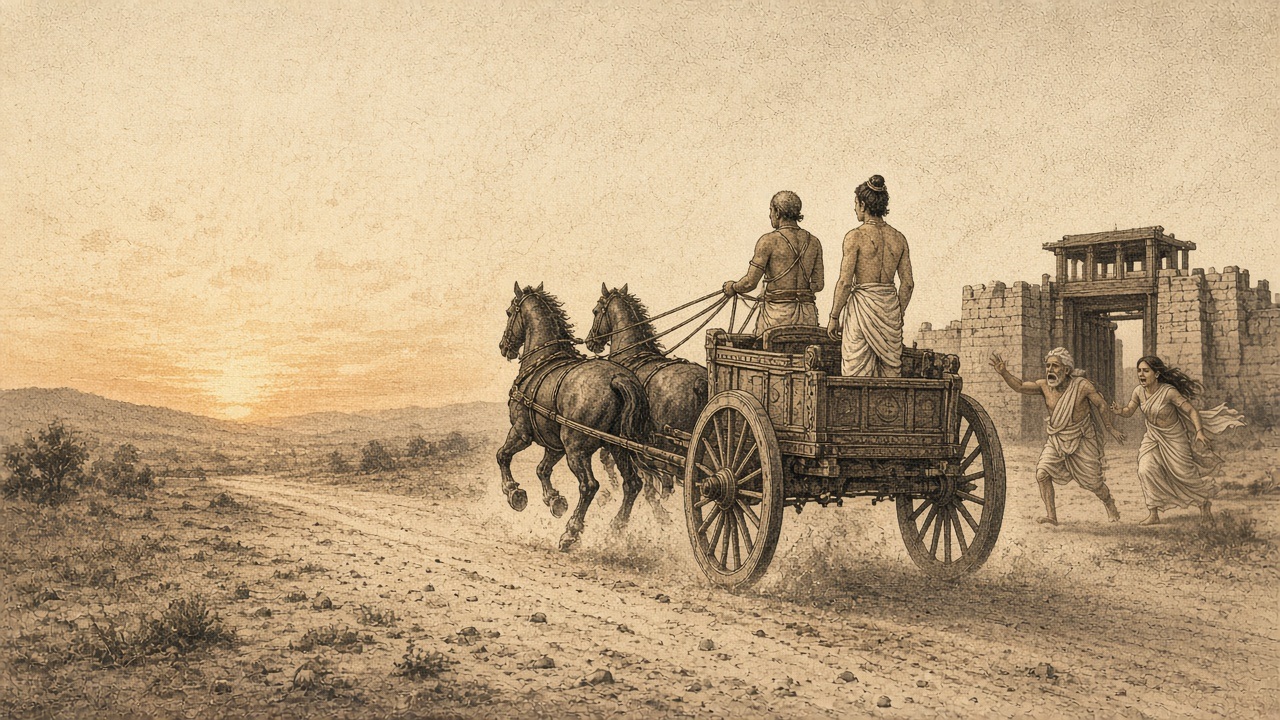
Rāma was twenty-five (3.45.10). On the day he was to be crowned, his father, King Daśaratha of Ayodhyā, had to honor an old promise to his queen Kaikeyī and send Rāma to the forest for fourteen years. The king then begged him to stay one night (2.31.26–27).
अहं राघव कैकेय्या वरदानेन मोहितः
अयोध्यायास्त्वमेवाद्य भव राजा निगृह्य माम्
ahaṃ rāghava kaikeyyā varadānena mohitaḥ
ayodhyāyās tvam evādya bhava rājā nigṛhya mām
The king says: I was a fool, misled by the boon I gave Kaikeyī. Tie me up, and be king of Ayodhyā yourself, today. Rāmāyaṇa 2.31.23
भवान्वर्षसहस्राय पृथिव्या नृपते पतिः
अहं त्वरण्ये वत्स्यामि न मे कार्यं त्वयानृतम्
bhavān varṣasahasrāya pṛthivyā nṛpate patiḥ
ahaṃ tv araṇye vatsyāmi na me kāryaṃ tvayānṛtam
Rāma answers: you rule the earth for a thousand years. I will live in the forest. I won’t have you made a liar. Rāmāyaṇa 2.31.25
प्राप्स्यामि यानद्य गुणान्को मे श्वस्तान्प्रदास्यति
अपक्रमणमेवातः सर्वकामैरहं वृणे
prāpsyāmi yān adya guṇān ko me śvastān pradāsyati
apakramaṇam evātaḥ sarvakāmair ahaṃ vṛṇe
Asked to stay one more night, Rāma says: who will give me tomorrow what I could have today? I choose to go. Rāmāyaṇa 2.31.29
Rāma’s chariot pulled out, with the king following on foot.
तिष्ठेति राजा चुक्रोष याहि याहीति राघवः
सुमन्त्रस्य बभूवात्मा चक्रयोरिव चान्तरा
tiṣṭheti rājā cukroṣa yāhi yāhīti rāghavaḥ
sumantrasya babhūvātmā cakrayor iva cāntarā
The king shouted “stop.” Rāma said “go, go.” The driver’s heart was as if caught between two wheels. Rāmāyaṇa 2.35.33
नाश्रौषमिति राजानमुपालब्धोऽपि वक्ष्यसि
चिरं दुःखस्य पापिष्ठमिति रामस्तमब्रवीत्
nāśrauṣam iti rājānam upālabdho ’pi vakṣyasi
ciraṃ duḥkhasya pāpiṣṭham iti rāmas tam abravīt
Rāma, to the driver: when the king blames you, say you did not hear. A long sorrow is the worst kind. Rāmāyaṇa 2.35.34
That first night he told Lakṣmaṇa that his father would sleep badly and that no mother should bear a son like him (2.47.6, 14, 21). His father died of it (2.58.57).
Good and Pleasant (Śreyas and Preyas)
श्रेयो हि धीरोऽभि प्रेयसो वृणीते
प्रेयो मन्दो योगक्षेमाद्वृणीते
śreyo hi dhīro ’bhi preyaso vṛṇīte
preyo mando yogakṣemād vṛṇīte
The steady one chooses the good over the pleasant. The dull one chooses the pleasant, to get what he wants and keep what he has. Kaṭha Upaniṣad 1.2.2
Why the Cards
Many Hindu families play cards on Diwali, the night of Lakṣmī. Dice cost Yudhiṣṭhira his kingdom (Mahābhārata, Sabhāparvan).
तस्माद्द्यूतं न सेवेत हास्यार्थमपि बुद्धिमान्
tasmād dyūtaṃ na seveta hāsyārtham api buddhimān
A wise person should not gamble, not even for a laugh. Manusmṛti 9.227
द्यूतं छलयतामस्मि तेजस्तेजस्विनामहम्
जयोऽस्मि व्यवसायोऽस्मि सत्त्वं सत्त्ववतामहम्
dyūtaṃ chalayatām asmi tejas tejasvinām aham
jayo ’smi vyavasāyo ’smi sattvaṃ sattvavatām aham
Kṛṣṇa says in the Gītā: among cheats I am the dice. I am the splendor of the splendid. I am victory, I am resolve, I am the goodness of the good. Bhagavad Gītā 10.36
Fiorillo, Tobler and Schultz, “Discrete Coding of Reward Probability and Uncertainty by Dopamine Neurons,” Science 299 (2003), recorded dopamine neurons in monkeys waiting on an uncertain reward and found sustained activity highest at even odds. The reading of Gītā 10.36 as a ladder, from stakes hidden from the other player (the cheat’s dice) to stakes in the open (the goodness of the good), is from Gaurav Rastogi, “I Am the Risk Among the Risk-Takers: A Neurochemical and Dharmic Reinterpretation of Bhagavad Gītā 10.36.” The five causes of every act, the fifth being daiva, fate or the divine, are at Gītā 18.14–15.
Walking Around the Planet
The world map on the slides takes its dates from Bergström et al., “Origins of modern human ancestry,” Nature 590 (2021), for the worldwide expansion 40,000 to 60,000 years ago; Kerdoncuff et al., “50,000 years of evolutionary history of India,” Cell 188 (2025), for a migration out of Africa about 50,000 years ago, the source of most genetic variation in Indians today; and the White Sands footprints in New Mexico, dated to 21,000 to 23,000 years ago (Bennett et al. 2021 and Pigati et al. 2023, Science), a date still debated. The route is a schematic.
The lamp
एतदन्यच्च करुणं विलप्य विजने बहु
अश्रुपूर्णमुखो रामो निशि तूष्णीमुपाविशत्
etad anyac ca karuṇaṃ vilapya vijane bahu
aśrupūrṇamukho rāmo niśi tūṣṇīm upāviśat
On the first night in exile, in that empty place, Rāma wept at length, then sat silent in the dark with his face wet. Rāmāyaṇa 2.47.27
विलप्योपरतं रामं गतार्चिषमिवानलम्
समुद्रमिव निर्वेगमाश्वासयत लक्ष्मणः
vilapyoparataṃ rāmaṃ gatārciṣam ivānalam
samudram iva nirvegam āśvāsayata lakṣmaṇaḥ
When he stopped, like a fire with its flame gone or a sea with no motion, his younger brother Lakṣmaṇa comforted him: Rāmāyaṇa 2.47.28
ध्रुवमद्य पुरी राम अयोध्या युधिनां वर
निष्प्रभा त्वयि निष्क्रान्ते गतचन्द्रेव शर्वरी
dhruvam adya purī rāma ayodhyā yudhināṃ vara
niṣprabhā tvayi niṣkrānte gatacandreva śarvarī
Surely Ayodhyā tonight, Rāma, with you gone from it, has no light, like a night with no moon. Neither Sītā nor I, he said, would live a moment without you. At sunrise they walked on. Rāmāyaṇa 2.47.29–33, 2.48.1
तेषामेवानुकम्पार्थमहमज्ञानजं तमः
नाशयाम्य् आत्मभावस्थो ज्ञानदीपेन भास्वता
teṣām evānukampārtham aham ajñānajaṃ tamaḥ
nāśayāmy ātmabhāvastho jñānadīpena bhāsvatā
Kṛṣṇa, of those devoted to him: out of compassion for them, standing inside their own being, I destroy the dark born of not knowing, with the shining lamp of knowledge. Bhagavad Gītā 10.11
The Hindu Spiritual Care Institute
Gaurav Rastogi is Dean and Co-Founder of the Hindu Spiritual Care Institute, which trains Hindu chaplains and spiritual care counselors. About HSCI.
Three Steps in the Dark. © 2026 Gaurav Rastogi. Gaurav Rastogi is Dean and Co-Founder of the Hindu Spiritual Care Institute. hsciglobal.org/keep-walking