Kutumba · Journal of Spiritual Care

kutumba

Journal of Hindu Spiritual Care
Volume 2 | Spring 2023
Download Full PDF
From the Editor

Welcome to Volume 2

Lakshmi Srinivasan
We are very happy to present the second issue of kutumba, the journal of the Hindu Community Institute (HCI). HCI trains professionals from all fields for community service and for further studies towards Hindu Chaplaincy. Our objective is to provide spiritual care and compassionate services to the broader community, regardless of race, religion or ethnic background.

In this issue, HCI President, Dr. Kailash Joshi and Dean Mr. Gaurav Rastogi highlight HCI's ambitious vision to develop both trained chaplains and dedicated CHTs to provide spiritual services in institutions and social support in the community, respectively.

Lakshmi Srinivasan, Chair, Kutumba Editorial Board
Counselor of Hindu Tradition Course

CHT Course Updates

HCI's Two-Course Configuration

Usha Narasimhan
Starting with the fall 2022 session, HCI offers two courses within a single Global Classroom. These courses are: the Hindu Chaplaincy Pathway (HCP) and Counselor of Hindu Tradition (CHT), respectively. With shared curriculum and group discussions, both of these courses meet the requirements of HCI's continuum of care model for the community. This model calls for complementary services offered by volunteers and chaplains at inter religious institutions and in homes.

The new learning format has three parts: the self-study, where one absorbs the material presented, a "brain-storming" session as a group of 3-4 scholars to refine understanding and generate reflections, and a final global discussion session with faculty.

Usha Narasimhan, HCI Registrar

AU
Amit Mehta

The Value of the CHT Program for Australian Communities

Hindu Community Institute (HCI) provides strong foundational training for community volunteers in the field of spiritual care. HCI's Counselor of Hindu Tradition (CHT) course is a graduate certificate course of 24-weekend sessions over 9 months. Through Karma Yogi scholars like me, the online course puts Hindu Tradition to work. The course teaches essential guidance in physical and spiritual well-being, palliative care, hospice care, and end-of-life care. The growing Hindu population of Australia is among the intended beneficiaries of these services.
Feature Articles — The HCI Vision of Chaplaincy
Feature

Chaplaincy: A New Frontier in Hindu Seva

Sunlit forest path
Success for a community comes from sound economic status and engagement on matters of interest of the greater community. While the prosperity and education of the Hindu community have been significant achievements, it is much less so when it comes to their participation in the welfare of the more significant inter-religious community. Today, it would be unusual, even remarkable, to go to a hospital, university, or tech firm and not see an Indian face in a prominent position. However, ironically, there are critical spaces where the Hindu faces are expected but mostly absent. The Hindu Community Institute (HCI) is now addressing this absence in the spiritual care domain through first-of-its-kind programs.

One prominent space with glaring Hindu absence has been "Spiritual Care and Chaplaincy." The mainstreaming of the Hindu tradition will not be complete until it is represented commensurate with its material and spiritual wealth.

Kailash Joshi & Gaurav Rastogi

HCI is simultaneously working to establish a global network of 1008 CHTs Counselors and 108 Hindu Chaplains by 2026-27. It expects to reach 30% of this goal in 2023.

Kailash Joshi & Gaurav Rastogi

Nandita Bhatnagar

Emergence of Hindu Chaplaincy

A Chaplain is an individual who has education in theology and is certified to provide spiritual care in a non-religious setting. While traditional religious leaders conduct religious services and are often attached to a specific congregation or house of worship, chaplains administer care to individuals and families in times of crises in hospitals, nursing homes, educational institutions and the military. Because chaplains are based in a community rather than a place of worship, they may be trained to minister to all faiths and can lead non-denominational religious services to benefit individuals from diverse spiritual backgrounds.

The Hindu teaching ekaṁ sad viprā bahudhā vadanty (Rig Veda 1.164.46) "Truth is One, Paths (Descriptions) are Many," provides a natural freedom for Hindu chaplains to easily incorporate different religious beliefs and traditions when providing spiritual care.

Nandita Bhatnagar
10
Sulochina Lulla

Welcoming a Hindu Chaplaincy Pathway

As a devout community volunteer, I welcome the new GTU-HCI pathway for the training of Hindu chaplains for service around the world. This is a great happening for Hindus everywhere. I would like to start with Gandhi ji's remedy for life's sorrows; "When doubts haunt me, when disappointments stare me in the face, and when I see not one ray of light on the horizon, I turn to the Bhagavad Geeta and find a verse to comfort me, and I immediately smile amid overwhelming sorrow."
Feature

Hindu Scholars in the Interreligious Chaplaincy Program

Dr. Kamal Abu-Shamsieh
Chaplains are unique leaders who provide spiritual support to people in various settings, including hospitals, military bases, universities, and prisons. They work with vulnerable communities and promote a sense of interconnectedness that reduces feelings of isolation and separation. In addition, chaplains play an essential role in building bridges among communities. In the Graduate Theological Union's Interreligious Chaplaincy Program (ICP), we began training Hindu chaplains in 2021. We teach how to listen to and support people with different religious beliefs, cultural traditions, and life experiences, all in an interreligious environment that facilitates dialogue and builds understanding among diverse communities.

The collaborative work of our chaplains has the potential to build bridges among communities through understanding, inclusion, and social justice. These spiritual care providers help break down barriers to build bridges of understanding, compassion, and empathy among diverse backgrounds.

Dr. Kamal Abu-Shamsieh, Director, Interreligious Chaplaincy Program, GTU

Advance Directives
Mukund Acharya

Why Do I Need an Advance Healthcare Directive?

The Advance Health Directive document serves two principal functions. It appoints an individual to act as your Health Care Agent and make decisions about your medical treatment when you cannot speak for yourself. It also guides your healthcare agent and medical professionals to make those treatment decisions in accordance with the wishes you describe on the form. The Health Care Agent is the surrogate decision maker or healthcare power of attorney.

The Advance Directive is a gift to both your family and yourself. It removes the burden and guilt of making the tough choices from your family's shoulders since the Agent is implementing your specific, written instructions.

Mukund Acharya

13
Kuttancheri Rema

The Critical Importance of Advance Healthcare Directives

Each of us has the privilege and responsibility to make our end-of-life decisions through an AHCD (Advance Healthcare Directive). This may be the single most important document we fill out in our lifetime, and it is an integral part of a routine Medicare wellness visit. Let me tell you a story: During a routine wellness visit, I had a discussion with one of my elderly, frail patients about his end-of-life wishes. He expressed a desire to avoid any aggressive intervention such as feeding tubes or ventilatory support and preferred to be kept comfortable at home. But he failed to put his wishes in writing or file an AHCD electronically.

If your doctor brings up an AHCD, it does not mean that something dire is happening to you. It is simply best to fill out Advance Healthcare Directives when a person is healthy and can think calmly about who they would designate to make medical decisions for them.

Kuttancheri Rema, M.D.
Serving the Community
Community Service

Dial-in Volunteer Services at HCI

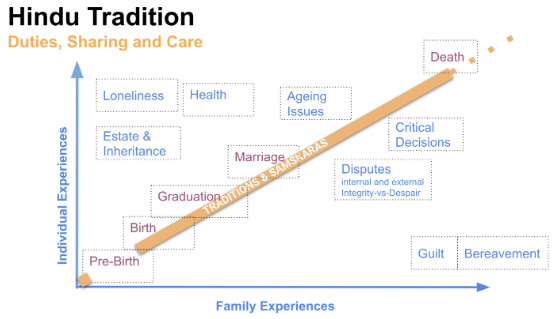
Hindu Tradition Duties, Sharing and Care lifecycle chart
Hindu Community Institute (HCI) Volunteer Service (VS) is an active effort to connect and serve our communities. It is integral to HCI's Learn Serve mission. The HCI VS has been operational since 2021 and is managed by experienced members who have graduated from the Counselor of Hindu Tradition (CHT) Course run by HCI. The Services offered are completely free and non-obligatory. The current VS services include guidance on celebratory events, pre-marriage and inter-religious marriage counseling, well-being and Hindu last rites. The services are accessible through a call-in number (415) 980-1415 attended by HCI volunteers in the Bay Area.

In the last 2 years, there have been more than 30 requests for counsel/guidance through our Last Rites Service. HCI volunteers and subject matter experts have been present on short notice to offer emotional support and guidance on rites in the Hindu-Vedic framework.

Anil Diddi
Meditation
Meditation

Recognizing Oneness: the Isha Upanishad as a Path to Empathy

यस्तु सर्वाणि भूतान्यात्मन्येवानुपश्यति ।
सर्वभूतेषु चात्मानं ततो न विजुगुप्सते ॥ ६ ॥
यस्मिन्सर्वाणि भूतान्यात्मैवाभूद्विजानतः ।
तत्र को मोहः कः शोक एकत्वमनुपश्यतः ॥ ७ ॥
When studying Vedanta, we encounter the recurring theme that human suffering arises from seeing oneself as distinct from others. In the above verses from the Isha Upanishad, it is emphasized that true contentment can be found by regarding the Atman (true self) as universal in all beings. "The Atman is common in the king and the peasant, the saint and rogue, the cobbler and the barber, the ant and the elephant, the tree and the stone. How can that great soul who is resting in his own Atman and who has such an exalted cosmic consciousness shrink from any being with a feeling of revulsion? How can he hate anybody? Absolutely impossible."

The Isha Upanishad affirms our capacity as humans for tremendous empathy and declares the deep interconnectedness of all existence. At HCI, we are embarking on training chaplains who are well-versed in Hindu tradition and who can also serve as interfaith chaplains.

Lakshmi Srinivasan — from the Isha Upanishad, Verses 6 & 7
Editorial Board

Kailash Joshi, Gaurav Rastogi, Lakshmi Srinivasan

journal@hinduci.com

← All Issues

Your gift — no matter what size — supports the training of Hindu chaplains worldwide

Support Hindu Chaplaincy
Support Us