Kutumba · Journal of Spiritual Care

kutumba

Journal of Hindu Spiritual Care
Volume 3 | Fall 2023
Download Full PDF
From the Editor

Welcome to Kutumba, Volume 3

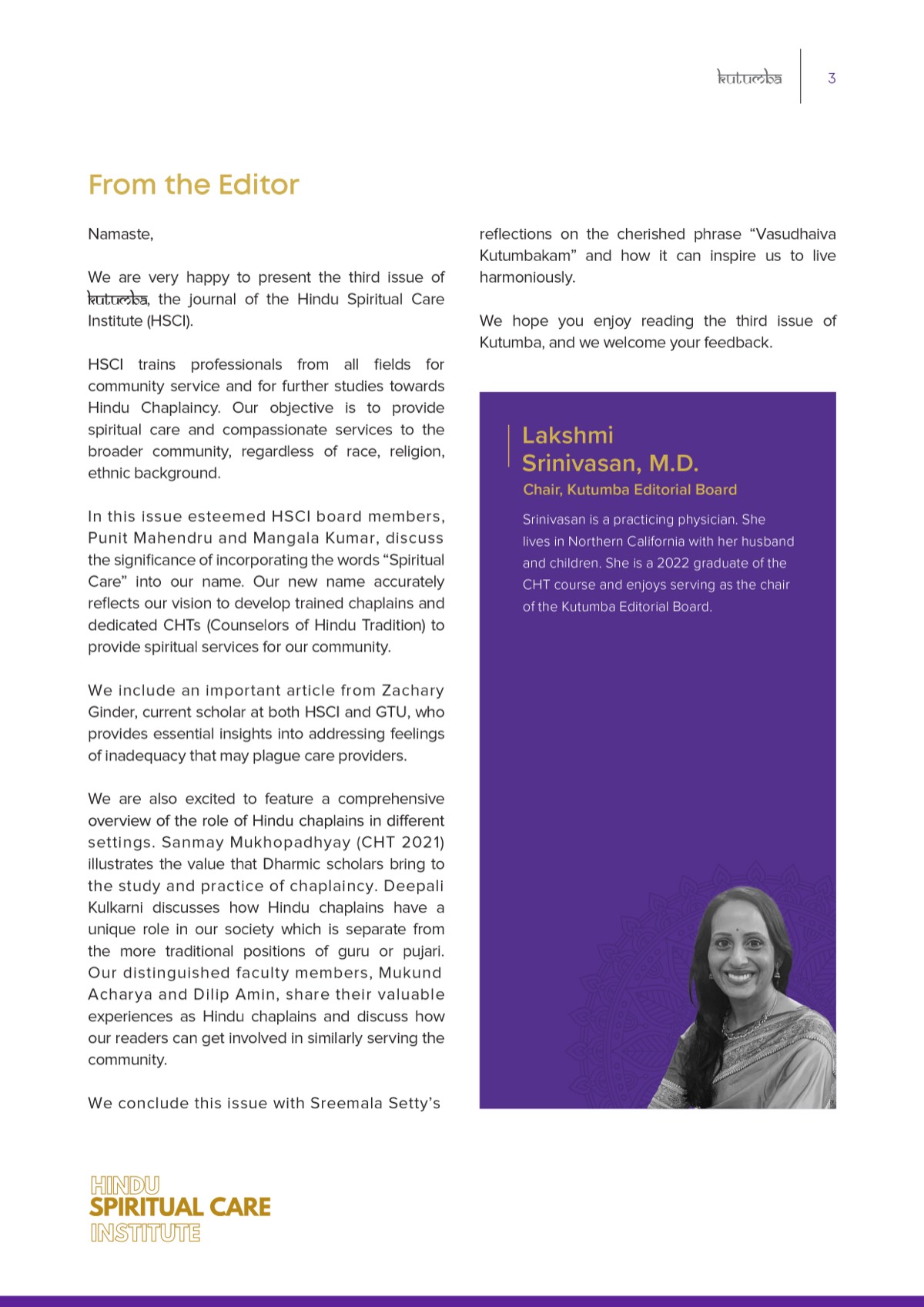
Lakshmi Srinivasan, M.D.
We are very happy to present the third issue of kutumba, the journal of the Hindu Spiritual Care Institute (HSCI). HSCI trains professionals from all fields for community service and for further studies towards Hindu Chaplaincy. Our objective is to provide spiritual care and compassionate services to the broader community, regardless of race, religion, ethnic background. In this issue esteemed HSCI board members, Punit Mahendru and Mangala Kumar, discuss the significance of incorporating the words "Spiritual Care" into our name.

We are also excited to feature a comprehensive overview of the role of Hindu chaplains in different settings. Sanmay Mukhopadhyay illustrates the value that Dharmic scholars bring to the study and practice of chaplaincy.

Lakshmi Srinivasan, M.D. — Chair, Kutumba Editorial Board
Hindu Spiritual Care Institute
HSCI logo on wall

HCI is now HSCI

HCI was launched in early 2018 with plans to offer a sustained and all-inclusive approach to compassionate care through social outreach, spiritual education, and pre-chaplaincy training. In July 2023, the HCI board members unanimously agreed to change the HCI name to HSCI, i.e., Hindu Spiritual Care Institute. The name reflects a focus on learning to provide service as counselors and chaplains informed by Vedic principles, during important life transitions within the Indian diaspora and beyond.

Spiritual Care is a rising interreligious field and a globally recognizable and accepted domain. As a Spiritual Care Institute we have chartered a course for Hindu chaplains for the first time.

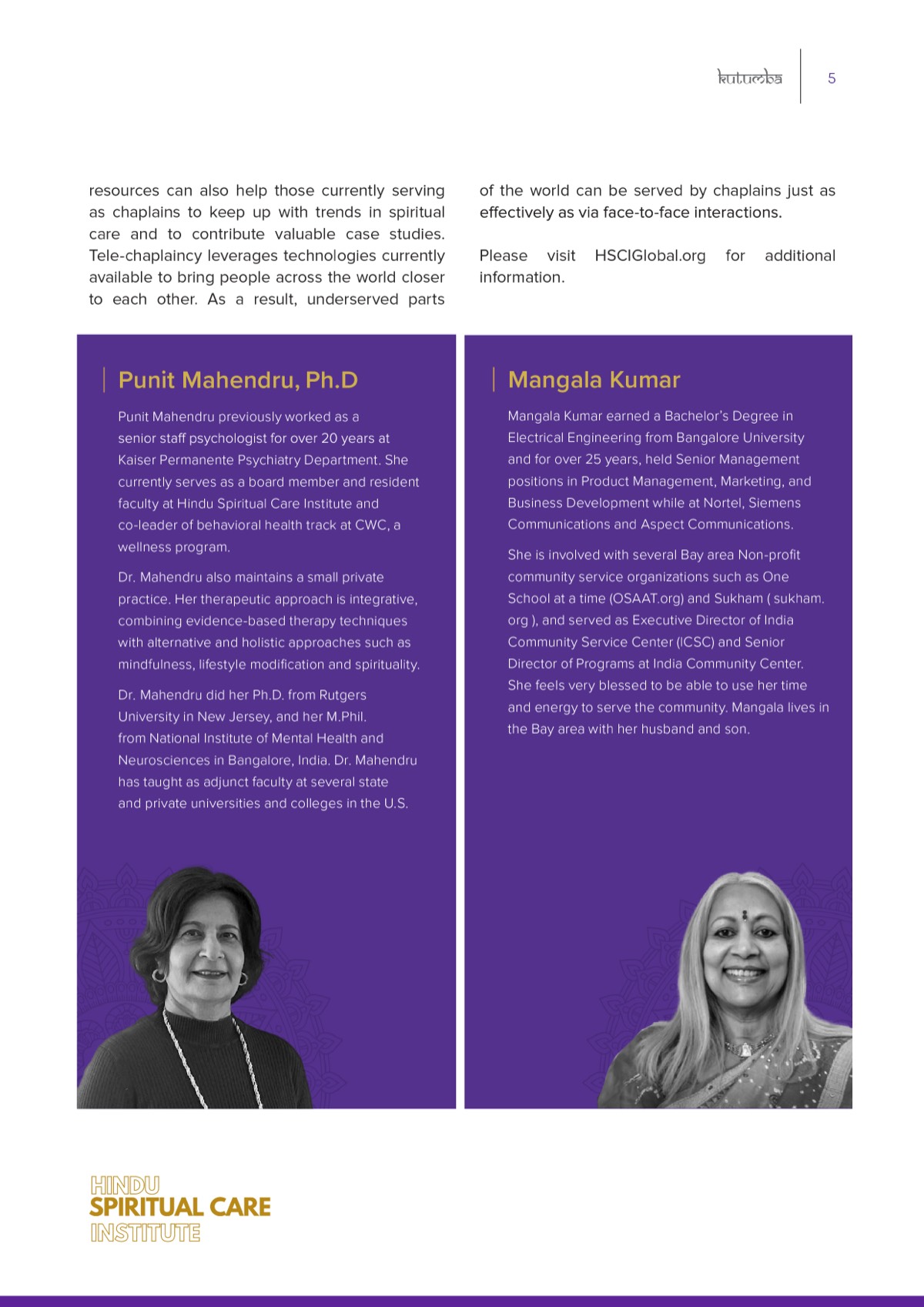
Punit Mahendru, Ph.D & Mangala Kumar
PM
Punit Mahendru, Ph.D

Punit Mahendru, Ph.D

Punit Mahendru previously worked as a senior staff psychologist for over 20 years at Kaiser Permanente Psychiatry Department. She currently serves as a board member and resident faculty at Hindu Spiritual Care Institute and co-leader of behavioral health track at CWC, a wellness program. Her therapeutic approach is integrative, combining evidence-based therapy techniques with alternative and holistic approaches such as mindfulness, lifestyle modification and spirituality.
Mangala Kumar

Mangala Kumar

Mangala Kumar earned a Bachelor's Degree in Electrical Engineering from Bangalore University and for over 25 years, held Senior Management positions in Product Management, Marketing, and Business Development while at Nortel, Siemens Communications and Aspect Communications. She is involved with several Bay area Non-profit community service organizations such as One School at a Time and Sukham, and served as Executive Director of India Community Service Center.
Learning to Serve
Feature

Overcoming Self-Doubt & Imposter Syndrome in Spiritual Care
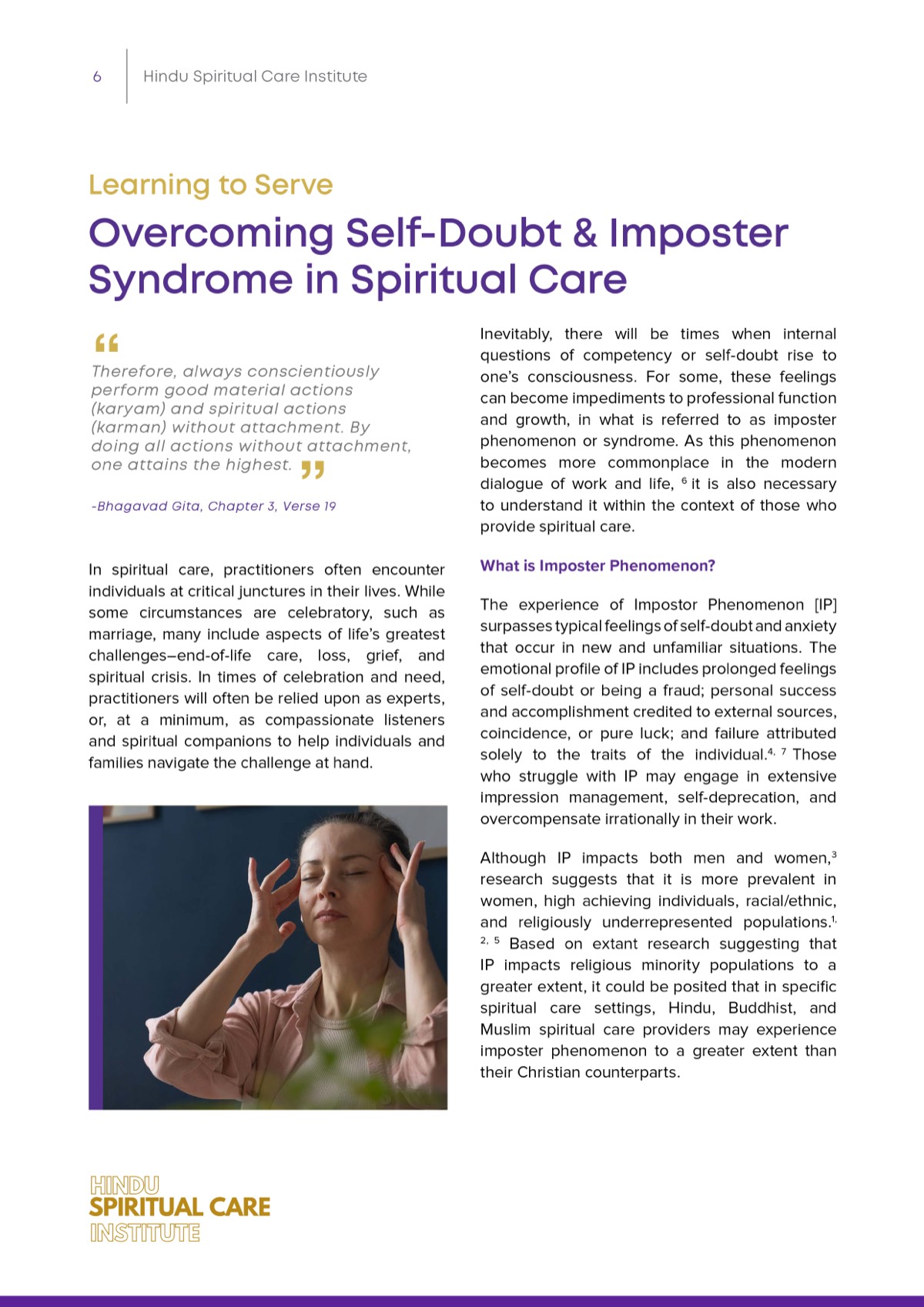
Person experiencing stress
Therefore, always conscientiously perform good material actions (karyam) and spiritual actions (karman) without attachment. By doing all actions without attachment, one attains the highest.
— Bhagavad Gita, Chapter 3, Verse 19
In spiritual care, practitioners often encounter individuals at critical junctures in their lives. While some circumstances are celebratory, such as marriage, many include aspects of life's greatest challenges — end-of-life care, loss, grief, and spiritual crisis. Inevitably, there will be times when internal questions of competency or self-doubt rise to one's consciousness. For some, these feelings can become impediments to professional function and growth, in what is referred to as imposter phenomenon or syndrome.

Treat yourself with kindness, concern, and understanding rather than criticism. Acknowledge that self-doubt is a normal part of human experience, and you are allowed to make mistakes on your path of learning and service.

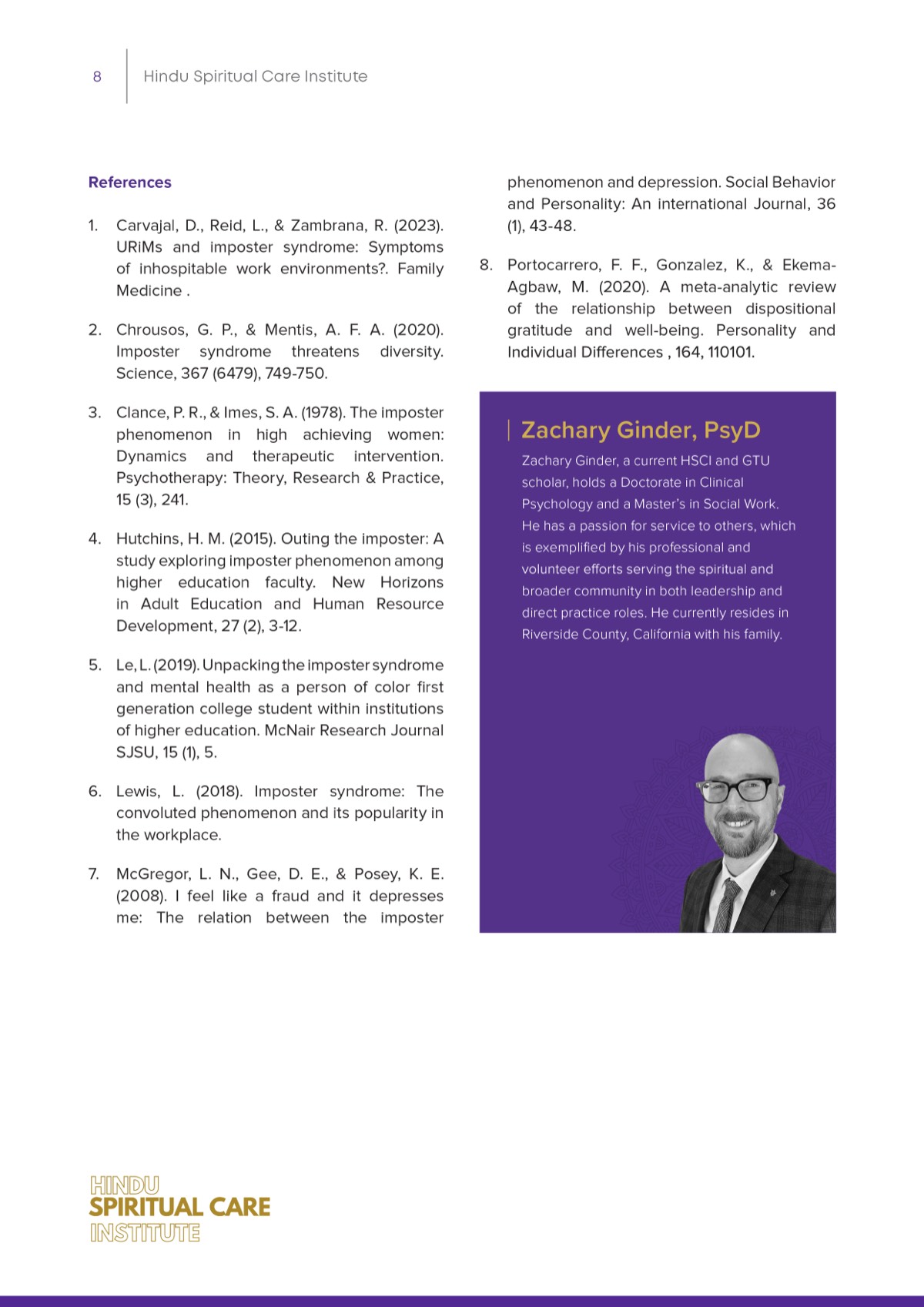
Zachary Ginder, PsyD
ZG
Zachary Ginder, PsyD

Zachary Ginder, PsyD

Zachary Ginder, a current HSCI and GTU scholar, holds a Doctorate in Clinical Psychology and a Master's in Social Work. He has a passion for service to others, which is exemplified by his professional and volunteer efforts serving the spiritual and broader community in both leadership and direct practice roles. He currently resides in Riverside County, California with his family.
Hindu Chaplaincy: What, Where, Why and How

The Budding Role of Chaplaincy in our Spiritual Garden of Pujaris, Sadhus, and Gurus

The religious leaders of Hindu traditions are numerous and multifaceted. Pujaris attend to mandirs and pujas; Sadhus renounce the world and lead by example; Gurus are teachers for specialized knowledge and for most, a guide on the ultimate spiritual path. Among these and other people tending the Hindu garden of spiritual care, you will find the humble budding role of chaplaincy. What started as a Christian position within select institutions has evolved into an opportunity for spiritual care for Jewish, Muslim, Buddhist, Africana, Humanist, and Hindu communities — among others.

Hindu chaplains have a unique opportunity to support the spiritual growth of patients, students, prisoners, soldiers, and other individuals during pivotal or difficult experiences. They create spaces for Hindu thought and practice at these institutions as a part of them, where Hindu voices may otherwise be lost.

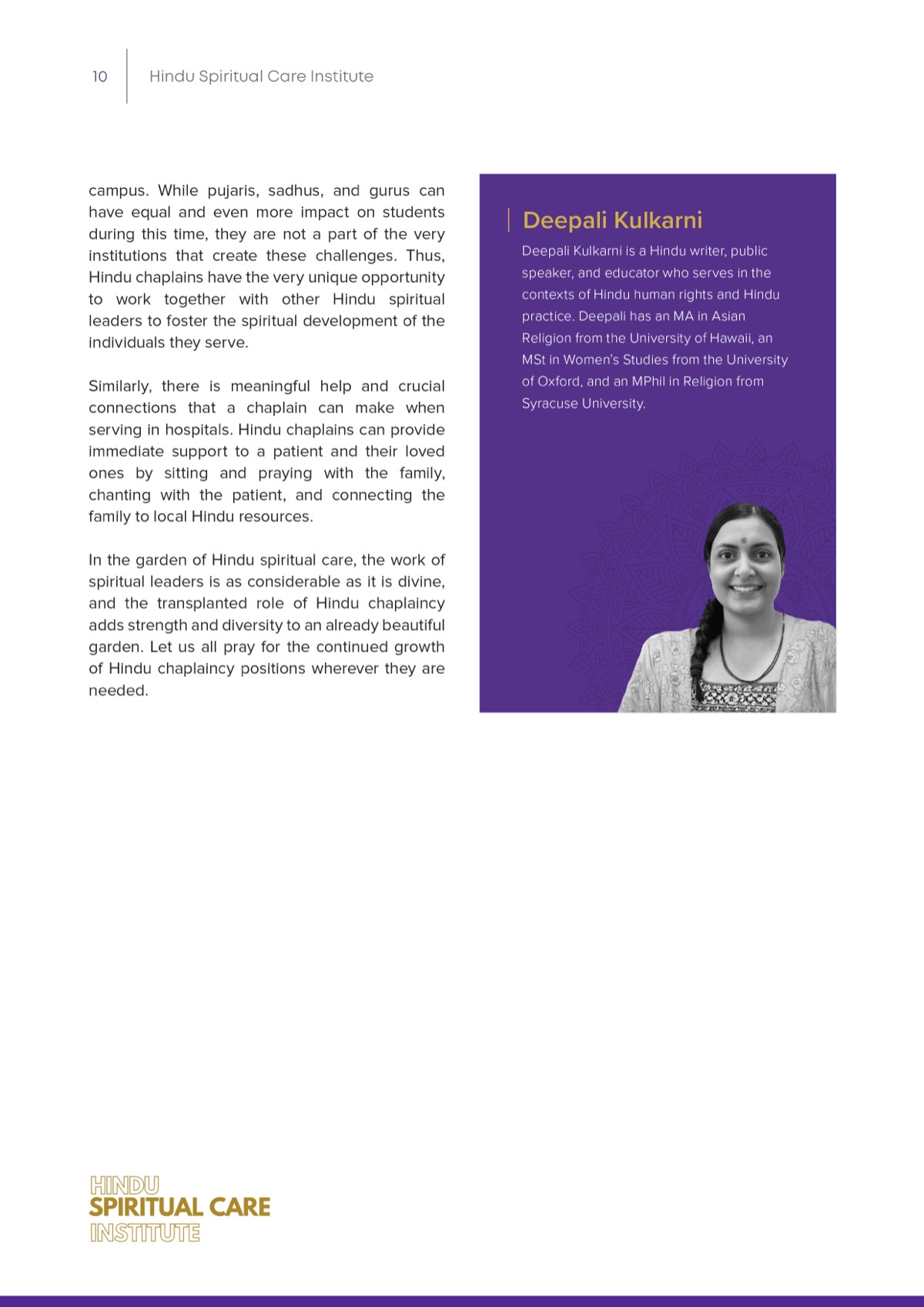
Deepali Kulkarni
Deepali Kulkarni

Deepali Kulkarni

Deepali Kulkarni is a Hindu writer, public speaker, and educator who serves in the contexts of Hindu human rights and Hindu practice. Deepali has an MA in Asian Religion from the University of Hawaii, an MSt in Women's Studies from the University of Oxford, and an MPhil in Religion from Syracuse University.
Where Hindu Chaplains Serve

Gel In and Gel Out: A Window into Spiritual Care Visits at a Major Hospital
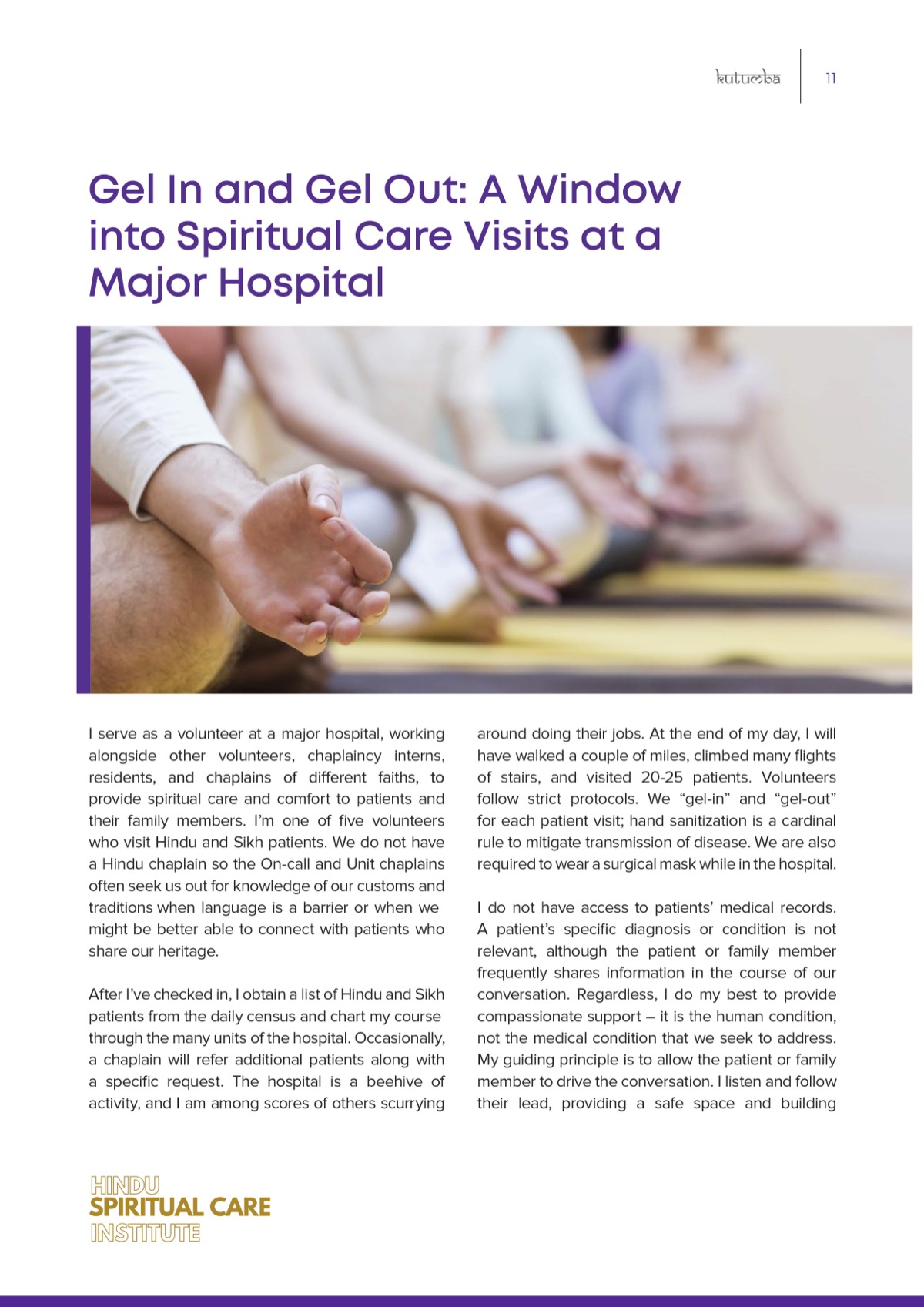
Spiritual care at hospital
I serve as a volunteer at a major hospital, working alongside other volunteers, chaplaincy interns, residents, and chaplains of different faiths, to provide spiritual care and comfort to patients and their family members. I'm one of five volunteers who visit Hindu and Sikh patients. We do not have a Hindu chaplain so the On-call and Unit chaplains often seek us out for knowledge of our customs and traditions when language is a barrier or when we might be better able to connect with patients who share our heritage.

I do my best to provide compassionate support — it is the human condition, not the medical condition that we seek to address. My guiding principle is to allow the patient or family member to drive the conversation. I listen and follow their lead, providing a safe space and building trust.

Mukund Acharya, Ph.D
MA
Mukund Acharya, Ph.D

Mukund Acharya, Ph.D
Mukund Acharya is Resident Faculty for the CHT Program, Director of Ananda Corps and Member of the Board of Directors at HSCI. He is also President and a co-founder of Sukham.
Jail chaplaincy

Why I Serve as a Hindu Chaplain in Jails and Prisons

Hindus should consider volunteering in jails to help inmates. It is very easy to be a volunteer jail chaplain and is a very rewarding and fulfilling experience. I have been such a volunteer for two San Francisco Bay Area jail systems for the past five years. One time, an inmate needed company to chant Hanuman Chalisa, and another time a non-Hindu inmate wished to learn more about Gita. Currently, if a Hindu inmate is seeking religious/spiritual guidance, they are offered available Christian or Muslim chaplains and books. There is a clear need for Hindus to fill the void and provide spiritual Dharmic support.

Volunteer jail chaplaincy is a great seva to members of our society in need that should not be forgotten.

Dilip Amin, Ph.D
Dilip Amin, Ph.D

Dilip Amin, Ph.D

Dilip Amin is the founder of interfaithshaadi.org and HinduSpeakers.org. He is also the Director of the Peninsula Multifaith Coalition of the San Francisco Bay area and on the Advisory Committee at the Hindu American Foundation. Dr Amin is a jail chaplain and a columnist at Patheos. He has written several books on his experiences dealing with people in interfaith marriages.
How Hindu Tradition Enriches Chaplaincy

How Hindu Tradition can Enrich the Practice of Chaplaincy

People who know me as a Yoga therapist, Ayurvedic practitioner, and practicing Hindu sometimes ask, "Why enter chaplaincy?" In my view, traditional Hindu and Dharmic principles will have a special role in enriching current chaplaincy practices. Bharat's Dharmic tradition can be summarized as Vasudhaiva Kutumbakam, meaning "the whole universe is my family." I believe that chaplaincy in the Dharmic tradition can offer a "supra-secular" approach which encompasses "all" without necessarily rejecting anything that sounds "religious."

Hindus can enrich chaplaincy by using Yoga, Yoga therapy, and Ayurveda as adjuncts to the assessment tools widely used in formal chaplaincy. These tools will add immensely to the understanding and care of individuals and can be extended to other domains of chaplaincy services such as prison education, corporate and military services.

Sanmay Mukhopadhyay
SM
Sanmay Mukhopadhyay

Sanmay Mukhopadhyay

For the last 35 years, Sanmay has practiced various Yoga lineages like Iyengar, Vinyasa, Hatha Yoga, and Patanjali Yoga. From his childhood, Sanmay grew up in the yogic culture and was initiated into yoga using Bisthu Ghosh's traditions. He has been teaching Yoga for the last 20 years and teaches in the USA and globally. Sanmay left his corporate executive job to spread the health benefits of Yoga and Ayurveda.
Meditation
Meditation

Vasudhaiva Kutumbakam

Mala Setty, Ph.D
Vasudhaiva Kutumbakam. This is HSCI's motto. Vasudha - eva - Kutumbakam. The world is one family. Vasudha is the network of life, the Earth Mother in whose womb we all live and thrive. Kutumbam means family. Members of a family are connected by relational networks of mutual well-being, of caring and nurturance. Vasudhaiva Kutumbakam sensitizes us to the caring aspect that binds families.

At the core of each one of us, and even in our relational processes, is the flow of spirit manifesting as the shakti of life. It is this spirit that is our ultimate family-bond. It is this spirit that makes our caring numinous and makes us see the divine in the small webs of our lives.

Mala Setty, Ph.D

Vasudhaiva Kutumbakam presents us with a wide, ever-evolving smorgasbord in which we can practice care, attention, love, wonder, and gratitude. HSCI sees the possibilities of spreading this sweetness of Hindu tradition to all corners of the world.

Mala Setty, Ph.D — from the Maha Upanishad
Editorial Board

Kailash Joshi, Gaurav Rastogi, Lakshmi Srinivasan

journal@hinduci.com

← All Issues

Your gift — no matter what size — supports the training of Hindu chaplains worldwide

Support Hindu Chaplaincy
Support Us